
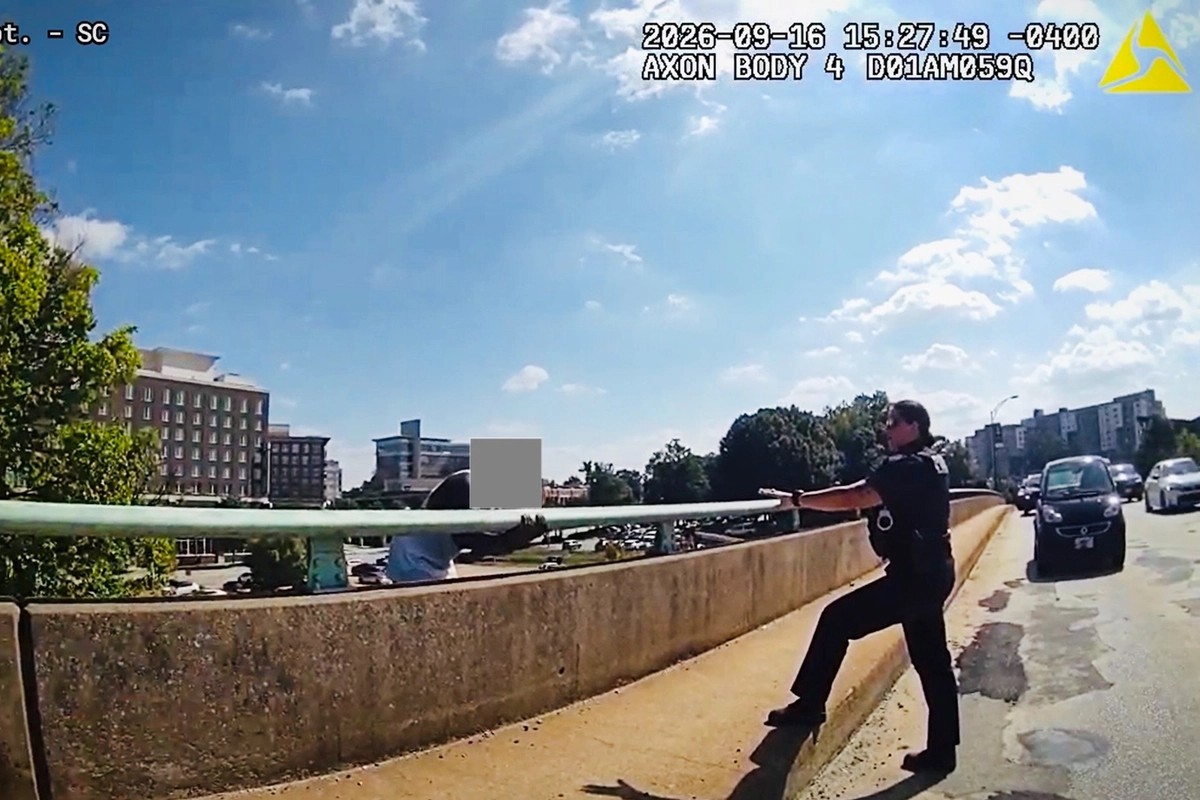
A city always has a way of gradually soothing its own wounds. On most workday afternoons, the South Academy Street Bridge in Greenville, South Carolina, is just a concrete passageway allowing commuters to leave downtown office buildings. The bridge is usually filled with the monotonous sound of car wheels rolling over the asphalt pavement.
However, on the afternoon of September 16th, around 4 p.m., a passerby witnessed a scene that disrupted the usual order, shattering the peaceful atmosphere. She flagged down Officer Caitlyn Holder, who happened to be patrolling nearby on McBee Avenue.
Someone had climbed over the railing of the bridge.
As Holder climbed up onto the concrete bridge deck, the dispatch center was coordinating traffic control. She naturally took on an assisting role, a practice that has now become a norm in American law enforcement. Holder had received crisis intervention training from the Greenville Police Department and responded as she had been taught: speaking slowly and listening patiently.
The man told her he was tired and wanted to die.
“Officers are trained at a high level to deal with situations like these,” Holder told The Epoch Times in an interview afterward.
Holder and officers like her have stepped up to fill the significant national infrastructure gap caused by the fragmented public mental health system. According to the National Alliance on Mental Illness, around 2 million people with mental health issues are incarcerated in the U.S. each year. This crisis on the street has led law enforcement to adopt new strategies – strategies that go against traditional law enforcement methods, not resorting to handcuffs, but relying on “proactive and reflective listening.”
“You never know what someone is going through,” Holder said. “Just because you may have never been in their shoes doesn’t mean you can’t take a minute to listen to their story.”
She mentioned a saying from her mentor, the late Officer Ashley Munoz – a beloved veteran officer who served at the department for 11 years – “You never meet a stranger.”
The Crisis Intervention Training (CIT) standard practice upends the usual “commanding authority” demeanor of police. This training doesn’t require officers to quickly take control of the situation but emphasizes consciously using words to de-escalate tense situations. Officers learn to deliberately lower their tone when speaking, use non-threatening body language to reduce the other person’s adrenaline levels. They also learn to employ strategic silences to buy time, rather than rushing to resolve the issue. Officers can also offer small choices to empower individuals in distress, giving them the opportunity to choose to live again.
Holder stood on the bridge deck separated by the railing, accompanying the man, waiting with him. She let the man lean on her shoulder, echoing his emotions to let him know he was being listened to. She gave him time, giving him the chance to change his mind.
Eventually, he asked for help.
Shortly after, he climbed back onto the safe side of the railing and was taken to the hospital.
“When many people lack the courage to seek help, he had enough courage to ask for it,” Holder told reporters afterward. “That really impressed me because when I was young, I too was afraid to seek help on bad days.”
The officer stated that her parents had taught her from a young age to put others before herself, which had become her calling.
On that day, Holder had to stand on the South Academy Street Bridge, for a simple reason: the entire system was exhausted from the successive blows it had faced.
Since 2020, there has been a significant increase in the demand for crisis intervention training, and behind this surge lies a deeper problem waiting to be addressed. The COVID-19 pandemic caused social isolation and economic pressure, leading to a nearly 40% spike in anxiety and depression among adults by early 2021, according to data from the Kaiser Family Foundation.
All this could be likened to a ticking time bomb ready to explode.
However, the crisis had been brewing for some time. From the 1960s to the early 21st century, the U.S. had been pushing for deinstitutionalization of mental hospitals, drastically reducing the number of psychiatric care beds by hundreds of thousands. At the same time, the community clinics that were supposed to take over care for these patients never fully lived up to their promise.
If this is a crack in the entire system, local law enforcement agencies have been on the front lines trying to clean up the aftermath of this systemic failure.
“Such situations remind us that as police officers, our duty is not just to respond to calls and rush to the scene,” the Greenville Police Department wrote in a statement posted online. “Sometimes, we need to be there for someone in their darkest moments, helping them find reasons and willing to take a step toward safety.”
The department praised Holder for showing “empathy, patience, and professionalism.”
Holder, however, was quick to credit her teammates for the success.
“Every one of us played our roles perfectly,” she said.
Holder also expressed special gratitude to another mentor, Officer Rachel Hall, who taught her that the measure of professionalism was not in how quickly tactical action was taken but in the willingness to patiently wait for time to heal slowly.
“We work 8 to 12 hours per shift, so there’s no rush to deal with any incident,” she said. “If someone wants to spend 8 hours telling me their story, I’m willing to listen.”