
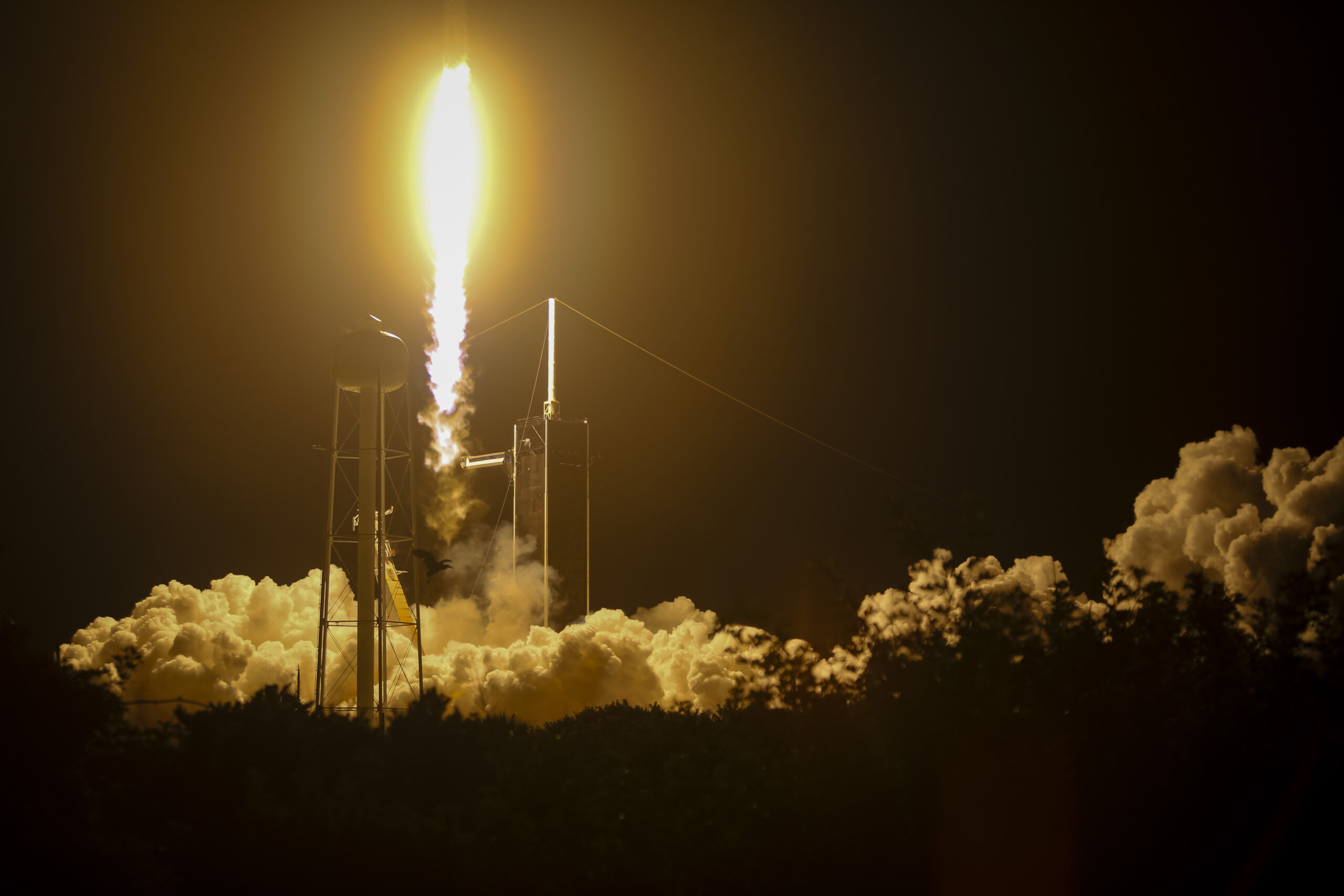
On Tuesday morning at 6:33 AM Eastern Time (October 13), SpaceX, an American space exploration technology company, successfully launched the Falcon 9 carrier rocket, carrying an unmanned Dragon spacecraft from Space Launch Complex 40 at Cape Canaveral Space Force Station in Florida into orbit.
This mission marked the 35th commercial resupply service (CRS) mission conducted by SpaceX under contract with the National Aeronautics and Space Administration (NASA), with the code name CRS-35.
The mission carried over 6,300 pounds (approximately 2,860 kilograms) of scientific research equipment and daily supplies, scheduled to autonomously dock with the International Space Station (ISS) and the Harmony module’s zenith port facing space around 11:00 AM on Thursday (October 15).
As a key annual space supply mission, the CRS-35 mission has four main highlights:
The most anticipated focus of this mission, according to NASA’s official press release, is the cutting-edge scientific experiment equipment it carries. The Dragon spacecraft transported hardware facilities used to manufacture “artificial retinas” in a microgravity environment.
Due to Earth’s gravity affecting the uniform deposition of protein membranes, the weightless environment in space provides excellent conditions for producing high-quality retinal substitutes, with the potential to assist blind patients in regaining their vision.
Additionally, the spacecraft also carried 3D heart tissue models and a brain organoid research project named MINDS. The 3D heart tissue will be used to advance large-scale drug testing for future long-duration deep space exploration missions.
The brain organoid research aims to reveal new treatment targets for neurodegenerative diseases such as Alzheimer’s, Parkinson’s, and multiple sclerosis (MS).
In addition to cutting-edge medical experiments, CRS-35 also bears the responsibility of upgrading the space station’s infrastructure. The cargo hold of the spacecraft carried the final pair of International Space Station Roll-Out Solar Arrays (iROSA).
As the operational lifespan of the space station increases, the power generation efficiency of the old solar panels has declined. The iROSA arrays utilize roll-out technology, covering the existing solar panels. The arrival and subsequent installation of the final pair of iROSA will significantly enhance the space station’s overall energy supply, providing stable power backup for the operation of more complex scientific experiments.
According to Space.com, among the active four international space station cargo spacecraft systems, including Russia’s Progress, Japan’s HTV-X, and Northrop Grumman’s Cygnus, SpaceX’s Dragon is the only spacecraft capable of safely returning cargo from space to Earth.
The other spacecraft are single-use and burn up in the Earth’s atmosphere after completing their missions.
The Dragon spacecraft is expected to dock at the space station for about a month. After the mission, it will carry a large amount of time-sensitive scientific research samples and equipment, safely splashing down with parachutes in the Pacific Ocean off the coast of California, ensuring the intact and undamaged return of space experiment results to Earth scientists.
The timing of the CRS-35 launch coincides with a particularly busy period for NASA’s orbital missions. Just before the launch, NASA and SpaceX held a media teleconference last Thursday (October 8), not only providing an early preview of the launch details of this cargo resupply mission but also briefing on the SpaceX Crew-12 manned spacecraft mission – the spacecraft safely returned four astronauts to Earth that morning.
This perfectly showcases SpaceX and NASA’s high level of maturity in commercial space operations – seamlessly transitioning from precisely managing the evacuation and return of crewed spacecraft to smoothly initiating the next round of heavy cargo resupply missions, ensuring the continued efficient operation of the International Space Station.