
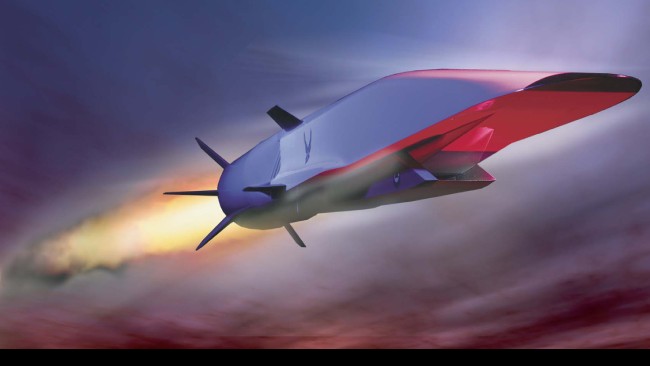
【Epoch Times October 12, 2026】The air-launched hypersonic cruise missile, due to its strategic importance in high-end conflicts, technical complexity, and crucial position in aerial strike capabilities, has always been a focus of external attention. Recently, there was news of the first flight test launch of the “Hypersonic Attack Cruise Missile” (HACM) as part of the US-Australia collaboration under the framework of the Southern Cross Integrated Flight Research Experiment (SCIFiRE), once again pushing the development process of this weapon system to the forefront.
On October 5, 2026, a spokesperson from the US Air Force confirmed that the United States and Australia had completed the flight test launch of the “Hypersonic Attack Cruise Missile” at a designated test site in Australia, under the operational execution of the Royal Australian Air Force (RAAF). Currently, there have been no official disclosures of specific test details.
The technical core of the HACM program lies in the challenging scramjet engine system it utilizes. According to reports from the US Government Accountability Office (GAO) regarding hypersonic weapon technology data and related information on HACM, the missile adopts a two-stage propulsion design: initially accelerated by a rocket booster to a speed at which the scramjet engine can effectively operate, then taken over by the scramjet engine to propel the missile for sustained supersonic cruise at speeds exceeding Mach 5 within the atmosphere.
On September 22, 2022, Raytheon and Northrop Grumman jointly announced that Raytheon would be responsible for the missile system integration, while Northrop Grumman would provide the scramjet engine, for the joint development of the HACM missile. Information released by the two companies indicates that the weapon system employs hydrocarbon fuel, utilizing air intake at high speeds for combustion to achieve sustained flight above Mach 5.
Different from hypersonic glide weapons relying on rocket boosters for high-altitude deployment, the hypersonic cruise missile with an air-breathing scramjet engine, under suitable flight speeds and intake conditions, utilizes oxygen in the atmosphere for fuel combustion, generating continuous thrust for flight at varying altitudes and maneuverability.
The US Air Force’s HACM design emphasizes high-speed flight, maneuverability, and penetration capability. By employing variable altitudes and maneuvering flight, it enhances capabilities against enemy air defense and missile defense systems. Due to its relatively lower flight altitude compared to typical ballistic missiles, along with its hypersonic speed and maneuverability, it helps reduce ground radar detection range and increases the difficulty of enemy air defense system detection, prediction, and interception.
Several air-breathing hypersonic aircraft with two-stage designs have entered the testing phase in the past, such as Boeing’s X-51 “Waverider” scramjet test aircraft, utilizing what is known as a “waverider” aerodynamic layout to improve aerodynamic efficiency during hypersonic flight by forming high-pressure airflow regions using shock waves generated by the body during high-speed flight.
Additionally, Castleion’s “Blackbeard” hypersonic missile also adopts a two-stage configuration, but it is currently unconfirmed whether the second stage of the weapon possesses propulsion, thus cannot definitively classify it as a hypersonic cruise missile.
It is almost certain that aircraft utilizing a scramjet engine, like the HACM, are highly unique, potentially possessing the ability to conduct high-speed cruise within the atmosphere, but also face considerable technical challenges. Scramjet engines must maintain stable combustion under conditions of supersonic airflow internally, while related weapon systems face engineering challenges such as aerodynamic heating, heat-resistant materials, and flight control.
The challenges in the development of hypersonic missiles in the US extend not only to the HACM which utilizes scramjet engines but also to various hypersonic weapon projects launched in the past decade by the Air Force, Navy, and Army, involving both air-launched and ground/surface-launched systems, which have encountered significant setbacks. However, the hypersonic cruise missile, in particular, is considered more challenging.
In 2025, the US Navy canceled its own air-launched hypersonic cruise missile program, the “Hypersonic Air-launched Anti-ship Attack Weapon” (HALO), and opted to replace it with the “Blackbeard” missile. (
Read more
)
Cost is also a significant concern. According to a report released by the Congressional Budget Office (CBO) in January 2023 titled “US Hypersonic Weapons and Their Alternatives,” the estimated unit procurement cost for the air-launched boost-glide hypersonic weapon AGM-183A ARRW, in a purchase of 300 units, is approximately $15 million per unit; however, if the procurement quantity reduces to 100 units, the average cost per unit rises to $18 million.
The HACM program, with more significant technical challenges, is generally perceived as a high-performance, expensive, and limited-deployment weapon, likely having even higher unit costs. In contrast, ammunition representing low-cost, mass-producible options like the “Blackbeard” reflects the emphasis placed on sustainable ammunition supply in modern warfare.
Recent conflicts between the US and Iran and other global crises highlight the importance of ammunition stockpiles. Especially in potential high-end conflicts with competitors like China, if the US military heavily employs expensive long-range precision strike weapons at the beginning of a war, it will face rapid depletion of ammunition stores and a severe test in maintaining continuous operational capability.
The US military may need to seriously consider the impact of costs on the deployable and consumable scale of ammunition.
In the future, the challenges facing the HACM may involve transitioning from technical validation and small-batch production to large-scale equipment deployment. Undoubtedly, considering the characteristics of the HACM being more suited for remote, high-value, time-sensitive target strike missions, the US Air Force may still be willing to bear the necessary costs to gain specific operational advantages.
Due to delays in the development schedule, flight tests for the HACM, originally planned to start in 2024, were pushed to 2026. The GAO’s annual weapons system assessment released on July 2, 2026,
stated
that the HACM program had taken a significant development risk to maintain its established R&D cycle. To accommodate the first flight test, some component verification work was carried out simultaneously with system design; if components fail verification, there may be a need to redesign critical parts.
To catch up with the delayed timeline, the program reduced the originally planned number of flight tests from 7 to 5, further compressing the adjustment space for schedule tuning post-test failures.
The report by GAO indicated that in case of a major flight test failure, the program would likely be unable to complete all 5 tests within the 5-year rapid prototyping development stage. The successful completion of the first 3 flight tests is crucial for the US Air Force to decide on initiating rapid deployment plans and procurement of the HACM in the 2027 fiscal year. However, as of the current situation, there remains significant uncertainty if these targets can be met on schedule.
The delay in the development program has raised concerns, especially since the US’s main global competitor, China, is working diligently on developing hypersonic weapons.
Both the US and Australia military authorities consider hypersonic technology vital for the development of long-range strike capabilities. In the “Defense Innovation, Science, and Technology Priorities” announced by the Australian Department of Defense in 2024, hypersonic weapons were recognized for their ability to deter potential adversaries further away from Australian territory; their high speed, maneuverability, and shorter flight time improve the survivability of the weapon and increase the difficulty of interception by adversaries.
The value of the US Air Force’s HACM lies in its hypersonic, long-range launch, and precision strike capabilities, particularly posing a lethal threat to high-value rapid-maneuvering targets.
The US Air Force explicitly states that this air-launched weapon is designed to allow aircraft to attack high-value, time-sensitive targets beyond defense zones, while retaining the capability for bombers to use such weapons for other strategic missions.
In a high-intensity conflict scenario that might occur in the Western Pacific, these capabilities are particularly critical.
Facing China’s so-called “anti-access/area denial” strategy, the US military might need more agile stealth aircraft to attack heavily defended military targets without entering enemy air defense firepower control ranges. The high-speed, long-range, and precision strike capabilities of hypersonic weapons can shorten the time from launch to target hit, increase the difficulty of detection, identification, and interception by adversaries.
The Congressional Budget Office (CBO) highlighted in its 2023
research that
hypersonic weapons might be suitable for environments built by adversaries like China’s “anti-access/area denial,” particularly for safeguarding high-value, time-sensitive targets under heavy protection. In cases where intelligence reveals the location of high-value targets but with a very brief attack window, rapid long-range strikes might hold strategic value.
In conclusion, air-breathing hypersonic cruise missiles provide a unique means of striking long-range fast-approaching targets, while compressing the response time of adversaries.
The US Air Force aims to commence small-scale production of the HACM by the end of 2027 or sooner. Years of delay have left the program’s schedule with virtually no room for error, making the successful completion of follow-up flight tests crucial in determining whether it can progress into the initial deployment phase on time.