
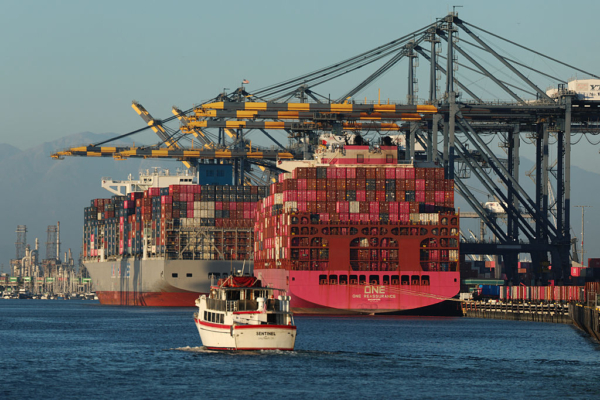
In breaking news from Epoch Times on October 12, 2026, the Port of Los Angeles achieved its busiest monthly record in its 118-year history in the month of September.
During that month, the port handled 1,042,652 standard containers (TEU), surpassing the previous record set in July 2025 by 20,000 containers. From July to September, nearly 3 million standard containers passed through the port. Including June, the port processed nearly 4 million containers, marking the strongest four-month record since its establishment.
Port data showed that in September, the import container volume reached 545,696 standard containers, a 19% increase from the previous year; the export container volume reached 125,751 containers, a 10% increase from the previous year, with a total of 371,206 empty containers, also setting a record high for the monthly port volume. In the first nine months of this year, the Port of Los Angeles handled nearly 8.1 million standard containers, a growth of over 3% compared to the same period last year.
Mayor of Los Angeles Karen Bass extended congratulations to the port on Sunday and thanked Port Executive Director Gene Seroka for his leadership and the hard work of the port employees. She stated, “The Port of Los Angeles experienced its proudest month in history, still serving as a powerful engine for the local and national economy, creating high-paying job opportunities for Los Angeles residents, and solidifying Los Angeles’ competitiveness in global trade and commerce.”
The Port of Los Angeles is the busiest port in the Western Hemisphere, providing high-paying job opportunities for tens of thousands of Los Angeles residents and serving as a major international trade gateway for the United States. The port handles a large volume of imports from Asia, serving as a primary gateway for Asian goods entering the United States, directly supporting the operation of wholesale, retail, and manufacturing industries across America, seen as a crucial engine for both Southern California and the U.S. economy.
In 2025, the trade volume of the Port of Los Angeles exceeded $300 billion; the top five trading partners were China/Hong Kong, Vietnam, Japan, South Korea, and Taiwan, with trade volumes of $82 billion, $48 billion, $45 billion, $21 billion, and $18 billion respectively. Northeast and Southeast Asian cargo throughput accounted for a combined share of 89%.
Seroka stated that September was a historic month and part of the extraordinary performance of the Port of Los Angeles. He believed that consumer demand remained strong, importers were replenishing inventory, and as other global trade routes faced challenges, more goods were being allocated to the Port of Los Angeles.
Seroka praised the port workers and supply chain partners for their outstanding performance in setting record cargo volumes and ensuring smooth cargo flow. He said, “After achieving the best month, quarter, and four months in port history, our goal is simple: to finish the year with strong momentum and continue to provide quality service to our customers.”
In an interview with The American Journal of Transportation, Seroka explained that multiple factors contributed to the surge in cargo at the Port of Los Angeles: ongoing growth in the U.S. economy, low water levels in the Panama Canal and safety issues in the Suez Canal led to over 5% of cargo being diverted from Atlantic and Gulf Coast ports; additionally, rising fuel prices made many import and export companies want to shorten shipping distances and expedite transit times to reach the market quickly. This has shifted many goods that were originally transported through the Suez Canal or Panama Canal to the Port of Los Angeles.
The Port of Los Angeles improved its pier infrastructure level this year. In July, Bass signed a cooperation agreement between the city, state government, and labor groups to replace or raise the Vincent Thomas Bridge connecting San Pedro and Terminal Island at the Port of Los Angeles, allowing the world’s largest and newest ships to pass through the bridge to enhance the port’s cargo handling capacity.
In August, the Port Commission appointed by Bass also approved a $66.5 million allocation to expand port road infrastructure, improve roads, and prepare for the 2028 Olympics.