
**Fantasy Epic Film “Once We Were Divine” Premieres in Taiwan, Gaining Acclaim**
Directed by Chinese filmmaker Yan Zhen, the fantasy epic film “Once We Were Divine” premiered at the Xile Times Cinema in Taipei on the 9th of October, attracting a large audience. Associate Professor Zhang Liyu from the National Pingtung University of Science and Technology praised the film for exploring the connection between humans, the universe, and the divine, calling it profound and worthy of multiple viewings.
Produced in collaboration by the Canadian “New Tang Dynasty TV” and New Realm Film and Television, “Once We Were Divine” is the final installment of Yan Zhen’s “For You I Came” trilogy. The film features prominent actors such as Jiang Guangyu, Cecilia Xiong, and the Shen Yun Art Troupe’s “Dance Trio.” The plot combines elements of fantasy and realism, delving into themes of gods descending to earth, the chaos caused by the red devil, and human salvation. It weaves together mythology, history, and reality, depicting the ancient gods and the Light King descending to earth, facing historical challenges, resisting persecution under the Communist Party’s oppressive rule, ultimately leading to the gods defeating the red dragon and returning to the realm of light.
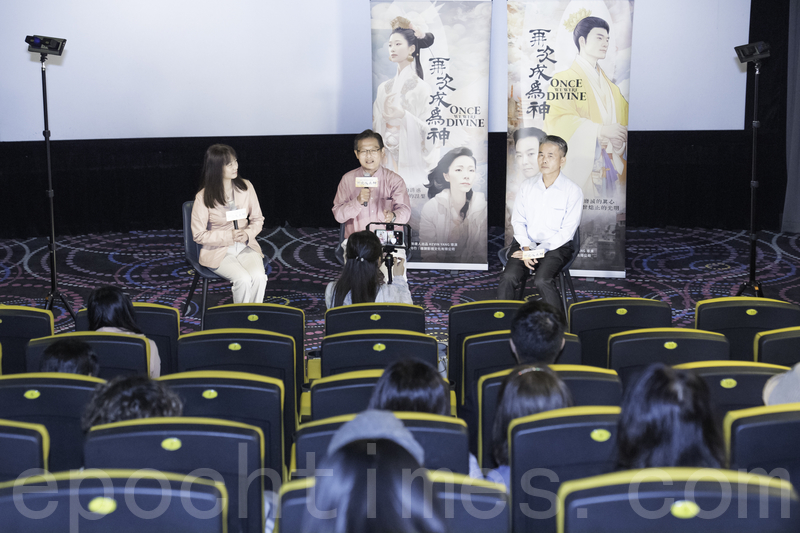
The film was introduced by Xiongshi Film and Cultural Company, who organized a premiere and discussion event in Taipei on the 9th. Following the premiere, the company’s manager, Guan Jianzhong, and former military prosecutor from the Ministry of National Defense, Li Zhengxiong, participated in a discussion.
Guan Jianzhong praised “Once We Were Divine” for its grand narrative spanning the celestial realms, ancient times, and the modern world, while touching upon themes of karma, reincarnation, and the return to the source of life. He highlighted the film’s portrayal of individuals helping others in adversity, the consequences of pursuing fame and wealth, and the importance of making correct choices. Guan Jianzhong expressed his admiration for the film’s depiction of the celestial world, stating that it evoked a sense of longing in him. He emphasized the philosophical aspect of the film in exploring the eternal mysteries of human existence, encouraging viewers to recommend the film to friends and family for a positive impact on societal moral values.
Li Zhengxiong commented on the film’s emotional impact, stating that “Once We Were Divine” conveys an important message about the inherent goodness of humanity and the importance of being virtuous. He reflected on the critical importance of thoughts and choices during pivotal moments, emphasizing that even minor deviations accumulated over time can lead individuals away from goodness and righteousness. Li Zhengxiong drew parallels between the film’s themes of good versus evil and the teachings of Confucius’s disciple Zengzi, underscoring the significance of self-reflection and ethical behavior.
Zhang Liyu, associate professor at the National Pingtung University of Science and Technology, shared her insights on the film, emphasizing its exploration of the connection between humans, the universe, and the divine. She advocated for individuals to rediscover their innate goodness and tap into their inner strength to contribute positively to the world at large. Zhang Liyu recommended “Once We Were Divine,” acknowledging its depth and complexity that merit contemplation, asserting that it is a film worth watching repeatedly for everyone.
She discussed the concept of human inherent goodness, highlighting how material pursuits like money and status can lead individuals astray from their true selves, resulting in a loss of invaluable human virtues and truths. Zhang Liyu emphasized the importance of holding onto truths despite hardships, believing that perseverance in upholding righteousness and truth is essential in navigating life’s challenges.
Poet and seal carving artist Guo Wenxuan expressed his admiration for the film’s ability to inspire audiences to reflect on concepts such as good and evil, faith, freedom, and life’s trials. He particularly resonated with the character of the “Nameless Sage,” interpreting it as a representation of one’s inner wisdom and ability to discern right from wrong. Guo Wenxuan expressed his belief in the potential for individuals to transcend to a divine level through goodness, emphasizing Taiwan’s conducive environment for democracy, freedom, and faith compared to the oppressive practices of the Communist Party in mainland China. He cautioned against the encroachment of the CCP into Taiwan and called for a collective commitment to walk the path of goodness.
With nearly 40 years of experience managing elderly care centers, former company executive Zhou Jincai reflected on the stark portrayal of good versus evil in “Once We Were Divine,” particularly under the pressures of the Communist regime. He commended director Yan Zhen for his nuanced character portrayals, environmental depictions, and vivid animated scenes that left a lasting impression. In contemplating the moral dilemma of choosing between good and evil, Zhou Jincai highlighted the challenges individuals face in staying virtuous, especially amidst the control exerted by the Communist Party. Despite the state machinery’s dominance in communist regimes, he remained steadfast in his belief that righteousness would ultimately triumph over evil.
Zhou Jincai underscored the importance of doing good deeds, speaking kind words, and understanding the law of cause and effect inherent in the concept of karma. He emphasized the cyclical nature of life, where being virtuous leads to positive outcomes and vice versa. He credited the film for evoking deep emotions and prompting him to ponder the implications of one’s actions on future outcomes.
Former Director of the Business Law Committee of the Taipei Bar Association, Lawyer Chen Yishen, reflected on the film’s depiction of the celestial and human realms, noting the interplay between the two seemingly separate worlds. He highlighted the film’s portrayal of the battle between divine and evil forces, particularly the temptations wielded by the red devil to manipulate and corrupt humanity. Chen Yishen drew parallels between the film’s narrative and the real-world actions of the Communist Party, equating their oppressive tactics to those of the red devil in the film. He perceived the current era as one marked by moral decay, emphasizing the need to reclaim one’s divine nature to combat negativity with righteous thoughts and wisdom.
Inspired by the film’s profound exploration of universal truths, Chen Yishen stressed the importance of disseminating knowledge and helping others understand the realities of the cosmos. He highlighted the essential role of spreading truth to awaken humanity and steer the world towards a brighter future.
Through concrete storytelling, the movie provided a deeper understanding of universal truths, urging viewers to uphold values and withstand challenges. The film left a lasting impact on the audience, prompting introspection and a renewed commitment to goodness and righteousness. As viewers absorb the profound messages of the film, they are encouraged to promote positive values and contribute to a brighter future for humanity.