
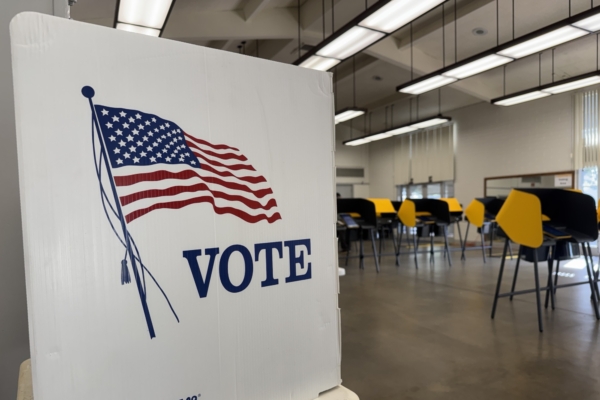
Near the upcoming midterm elections in the United States, voters across California are expected to receive sample ballots soon. Meanwhile, the federal government is intensifying its efforts to combat illegal voting. According to regulations, non-citizens who falsely claim to be U.S. citizens and participate in federal elections could jeopardize their immigration status.
The U.S. Citizenship and Immigration Services (USCIS) recently publicized a case on social media where a foreign national, who had not planned to apply for citizenship, falsely claimed to be a U.S. citizen, registered as a voter in Nevada, and participated in the 2024 election.
The immigration agency stated that the applicant is suspected of violating relevant laws. Under federal law, only U.S. citizens are eligible to participate in federal election voting. Therefore, when reviewing citizenship applications, the immigration agency carefully checks whether the applicant has illegally voted or falsely claimed to be a U.S. citizen.
Furthermore, the federal government is stepping up efforts to handle cases of revoking citizenship. In a guideline updated by the immigration agency in September, two main reasons for civil denaturalization were clarified: 1. Illegally obtaining citizenship eligibility; 2. Concealing important facts or making intentional false statements.
In June of this year, the Department of Homeland Security (DHS) instructed Immigration and Customs Enforcement (ICE) to deport foreign nationals who voted in U.S. elections.
In a letter addressed to ICE leadership, the DHS cited the Immigration and Nationality Act, which stipulates that foreign nationals who illegally vote or falsely claim to be U.S. citizens could be subject to lawful deportation.
According to regulations, even legally residing foreign nationals in the U.S. may face deportation consequences if they illegally participate in U.S. elections; immigration authorities can take deportation measures as specified even without criminal convictions.
On September 24th, Homeland Security Investigations (HSI) and the Federal Bureau of Investigation (FBI) arrested a green card holder who had unlawfully voted in New Jersey. She was charged with fraudulently obtaining citizenship or applying for naturalization, and illegally voting as a foreign national.
On the 17th, HSI and ICE arrested a Mexican green card holder who had illegally voted in the 2015 U.S. election. He was charged with illegal voting and falsely claiming citizenship, awaiting deportation.
On the 10th, an individual from Peru was arrested by HSI special agents, accused of impersonating a lawful citizen and voting in the 2024 election in Sedgwick County, Kansas. She had checked “Yes” when asked on the voter registration form whether she was a U.S. citizen. Agents determined she violated U.S. immigration law and brought her to the local ICE facility for further processing.
In August, an illegal immigrant was sentenced for illegally participating in election voting for over two decades through identity theft.
In recent California elections, there have been frequent reports from individuals who are not U.S. citizens, not legally registered voters, yet received sample or official mailed ballots; some shared experiences of unexpectedly receiving mailed ballots on social media.
For instance, during the 2024 election period, a Los Angeles County resident, Mr. Albert Zhang, received a mailed ballot though he knew he was not a U.S. citizen. He promptly chose to destroy the ballot.
Mr. Zhang then informed his immigration lawyer of the situation. The lawyer commended his actions, as illegal voting could potentially impact future immigration applications.
The lawyer reminded Mr. Zhang that such issues can sometimes be confusing but the principle is simple: if not a U.S. citizen, one cannot vote or register as a voter. When encountering the question “Are you a U.S. citizen” on any form or document, one must answer truthfully; until naturalized, one cannot tick “Yes”.
The question “Are you a U.S. citizen” is also common when applying for identification or driver’s licenses at the California Department of Motor Vehicles (DMV).
Furthermore, similar questions may appear on the tax forms of American taxpayers next year. According to the latest draft tax forms for the next filing season by the Internal Revenue Service (IRS), the 1040 tax form includes relevant questions, requiring taxpayers and their spouses to answer whether they are U.S. citizens, U.S. permanent residents, or foreign nationals lawfully working in the U.S.