
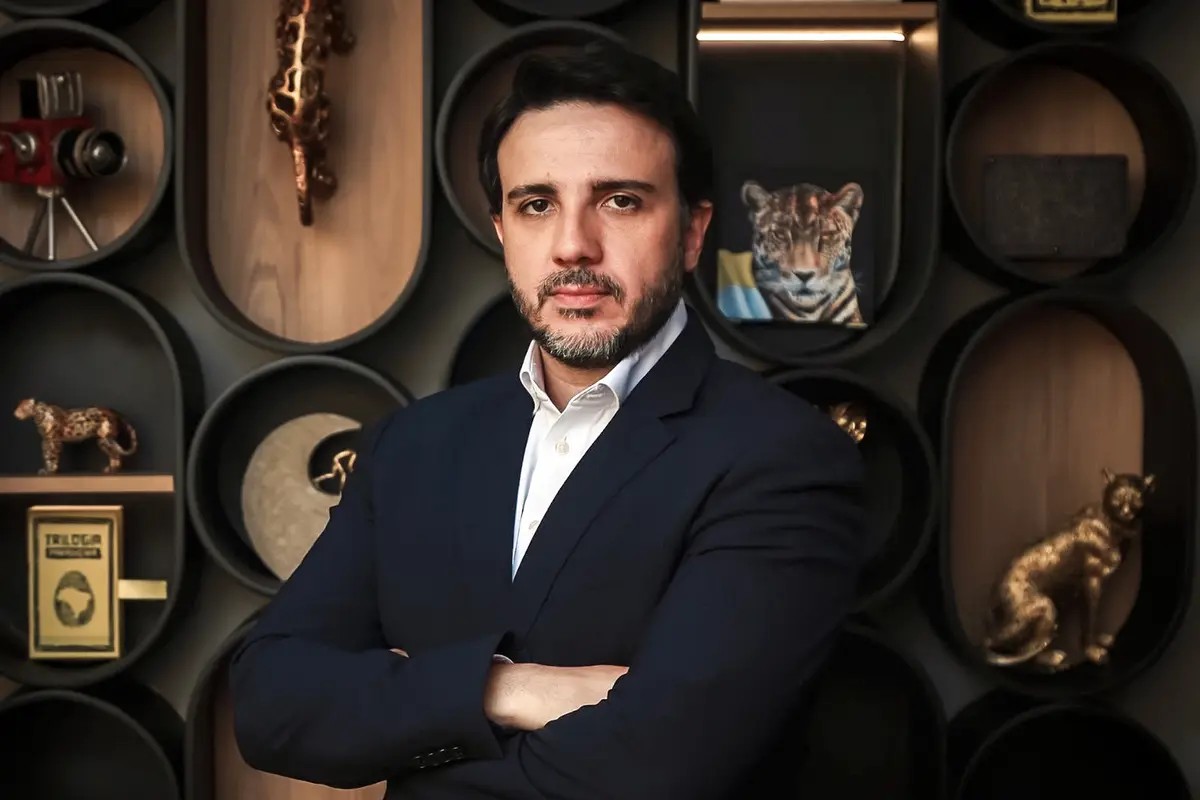
Brazilian presidential candidate Renan Santos has always been outspoken: in his view, truth is politically incorrect.
Santos told The Epoch Times, “People in many developed countries say, ‘Oh my, we don’t want to become like Brazil.’ I want to prove to them, ‘Well, we can de-Brazil-ify Brazil, we can save Brazil.'”
On August 31, this activist made headlines when Brazil’s Supreme Court justice José Antonio Dias Toffoli essentially ended Santos’s campaign by delaying the registration of his accounts on social media platforms. A day later, amidst strong public protests against the court’s decision, Toffoli overturned the initial ruling, stating that it was merely a precautionary measure, and allowed Santos to resume receiving campaign donations and participating in debates.
So, who is Renan Santos? How will he “de-Brazil-ify” Brazil?
Over a decade ago, Santos rose to prominence for leading anti-government protests, harboring grand ambitions and having his own political platform – the Mission Party. Inspired by Argentine President Javier Milei and Salvadoran President Nayib Bukele, Santos and his allies express their desire to combat organized crime, reform bureaucratic institutions to align politicians’ interests with the public good, and lead Brazil on an independent path on the international stage.
While some polls show Santos’s support is rising, especially among young Brazilian voters, he still faces a tough challenge in the presidential election on October 4. His opponents include influential leaders in the Brazilian right-wing camp, whose political agendas bear some similarities to Santos’s – notably Senator Flávio Bolsonaro, whose father is former Brazilian President Jair Bolsonaro, currently serving a 27-year sentence under house arrest.
“Renan Santos and his Mission Party are not truly anti-establishment forces,” former Brazilian Foreign Minister Ernesto Araujo told The Epoch Times.
Santos has stated that he could never support young Bolsonaro, often criticizing him on social media. Despite their controversial stances, Flávio Bolsonaro publicly opposes Toffoli’s preliminary ruling against Santos.
In the short term, Santos may struggle to win the election, but his visionary ideas – including building a disciplined political party and unique marketing strategies – are causing political waves in South America. This politician and psychedelic rock musician, originally an anti-corruption activist, even as a runner-up, could still wield influence if the election eventually evolves into a second-round showdown between Bolsonaro and current left-wing President Luiz Inácio Lula da Silva, known as Lula on October 25.
A South American prominent journalist, who requested anonymity, described Santos as “very smart.”
“He has no chance of beating Lula and Bolsonaro, but he wants to play the role of kingmaker in the second round of voting,” added the journalist. He predicted that Santos might leverage his first-round votes as chips to advance his agenda and potentially gain power in the eventual government.
Before founding the Mission Party and running for president, Santos co-founded the Free Brazil Movement in 2014, a pro-free market political organization.
At the time, mounting public dissatisfaction with then-President Dilma Rousseff, a member of the left-wing Workers’ Party like Lula, led to widespread protests.
Santos recalled feeling frustrated in 2013 when friends led left-wing protests against Rousseff, prompting him to challenge Rousseff from a different ideological standpoint.
During this period, the Operation Car Wash investigation exposed widespread corruption within state-owned Petrobras and led to scandals involving bribery, kickbacks, and other corrupt schemes within Brazil’s major construction companies monopolies.
Santos’s pro-market organization, the Free Brazil Movement, was a major player in the 2015 and 2016 protests against Rousseff. Growing public anger ultimately led to her impeachment and removal, despite never being convicted of any crimes.
Additionally, Lula was embroiled in corruption scandals.
The political figure who served as president before Rousseff was arrested in 2018 as part of Operation Car Wash. In 2019, Brazil’s Supreme Court ruled that the defendant could not be imprisoned until exhausting all appeals, leading to Lula’s release. In 2022, Lula was re-elected president.
The political wave that fostered the rise of the Mission Party propelled Jair Bolsonaro to the presidency. Like Lula, he faced imprisonment after relinquishing office – accused of plotting to overthrow the government after Lula’s victory.
Santos mentioned that the early Free Brazil Movement, though leaning towards social conservatism, also had “some kind of liberal flavor.”
He also remarked that he was never a thoroughgoing libertarian, but believes that given the level of government intervention in the private sector in Brazil, some liberal policies are at least needed as remedies.
Today, as the leader of the Mission Party, Santos embodies a more unorthodox force.
“We don’t care too much about labels,” he says. He praises a rather illiberal model in Central America – the Bukele model, known for its strict crackdown on gang activities in El Salvador, albeit criticized by human rights organizations.
Regarding Brazil’s future, Santos draws inspiration from Austrian writer Stefan Zweig from the early 20th century.
As fascism and militarism rose in Europe, the Austrian Jewish intellectual sought refuge in South America, penning “Brazil, Land of the Future” in 1941.
Zweig believed his second home, Brazil, could be a model for a peaceful, harmonious multiethnic society committed to development.
Factors such as poverty, violent crime, periodic military coups, and political mismanagement – not to mention racial tensions destabilizing Brazil’s multiethnic self-image – have hindered Brazil from fulfilling Zweig’s idealistic portrayal.
Santos believes Brazil can forge its path and become capable of leading the tropical civilizations of the Global South towards a successful future.
His roadmap includes a “defavelization” plan, aiming to eradicate slums across the country – breeding grounds for much of Brazil’s organized crime.
“We can achieve this within 10 years,” he said, outlining a plan that involves building new housing and streets, regularizing property ownership for residents, reforesting areas, and “arresting or killing all drug cartel bosses.”
“That’s no big deal,” he added.
Santos also aims to cut public spending by merging municipal authorities and streamlining bureaucracy.
Interestingly, he believes that the path to reforming the bureaucratic system lays precisely through a seemingly entrenched feature of Brazil’s political landscape: patrimonialism.
Speaking of politicians in Brazil favoring nepotism, corruption, and blurring the lines between the public and private spheres to accumulate personal power and wealth, Santos said, “We’ve spent at least 100 years fighting this patrimonialism.”
His proposed Managerial Responsibility Act aims to tie this spirit with merit and efficiency, rewarding officials who achieve clear goals with more money and power, while penalizing those who fall short.
“Hereditary leadership was once a problem, but with technology support, it can become a solution,” he said.
Santos’s remarks seem to resonate with some Brazilians, especially among the youth.
A poll from July this year found that 7.8% of Brazilians plan to support Santos in the first round of voting. Among respondents aged 16 to 24, this figure rises to 37.9% – exceeding the support for Lula or Bolsonaro in that age group.
Santos describes Bolsonaro’s voters as “a boomer vote,” differing little from the voter demographic supporting Lula.
An unnamed insider from the Mission Party revealed Santos is “playing a very long game.”
As right-wing political forces grow in Latin America, Santos may either make a mark or continue to dream, and time will tell.