
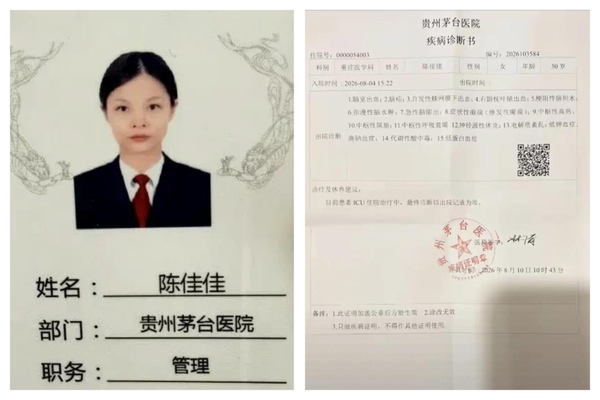
In August this year, a 30-year-old female nurse in Zunyi, Guizhou province suffered a sudden cerebral hemorrhage while on duty and unfortunately passed away after 10 days of rescue efforts, leaving behind an 8-year-old son. Recently, the decision of the Zunyi City Human Resources and Social Security Bureau to not recognize the incident as a work-related injury has sparked controversy.
According to a report by “Huashang Bao • Dafeng News” on September 25th, Chen Jiajia, before her passing, was the head nurse of the Medical Imaging Department at Guizhou Maotai Hospital, where she had worked for about 8 years. On the afternoon of August 4th, she experienced symptoms such as headache and nausea while at work. Her colleagues immediately sent her to the CT room for examination, which revealed intracranial bleeding. She was then transferred to the emergency department and neurosurgery for treatment.
That afternoon, she underwent cranial surgery in the operating room and was not finished until around 11 p.m. The diagnosis was “spontaneous subarachnoid hemorrhage, intraventricular hemorrhage, acute brain herniation.” She remained in a coma since then.
Her mother, Mrs. Lin, stated that on the second day of the incident, they requested to transfer her to another hospital for treatment, but the doctor said the conditions for transfer were not met. It wasn’t until August 13th that the hospital informed them they could be transferred. Around 6 a.m. the next day, she was transferred to the Southwest Hospital in Shapingba District, Chongqing, using an ambulance.
Mrs. Lin mentioned that based on expert diagnoses, her daughter was brain dead, which left them devastated. Upon returning to their hometown in Maotai Town, they quickly arranged for another ambulance, but unfortunately, her daughter stopped breathing just 5 minutes after arriving home that evening.
On September 17th, the Zunyi City Human Resources and Social Security Bureau conducted an investigation and determined that Chen Jiajia’s condition was a sudden illness during work. However, her death after 10 days of rescue did not meet the conditions for being considered a work-related injury as stipulated in the “Work Injury Insurance Regulations,” which led to the decision of not recognizing it as such. The health bureau of Renhuai City responded that they are handling the matter according to regulations.
In response to this decision, Mrs. Lin expressed that her daughter underwent annual check-ups, had no underlying health conditions, and was subjected to heavy workloads, often being called back to the hospital for overtime work even late into the night. With her daughter’s sudden illness and subsequent passing within just 10 days, she expressed disbelief that the extended rescue time disqualified it from being classified as a work-related injury.
Reportedly, Chen Jiajia was known for her excellent needle techniques among her colleagues and patients, earning her the nickname “Chen Yizhen.” She had previously won the third prize in the “2020 Labor Competition” nursing category and held the title of “Outstanding Medical Practitioner of 2021.” She also supported frontline efforts during the pandemic. The official handling of the situation has stirred controversy, with most netizens overwhelmingly supporting the family.
Netizens commented, expressing concerns over the high-risk nature of nursing as a profession, the lack of sleep and high work pressure, and the limited rest time for nurses. They criticized the rigid 48-hour time frame for work-related injury compensation, questioning the necessity of discontinuing treatment after that period. Some even criticized the regulations as being unreasonable and detrimental.
Tech blogger “Zhuang Laoshi Youdu” remarked, “Just learned a new piece of knowledge: to qualify for work-related injury compensation, one must give up treatment within 48 hours.”
Headline writer Ma Yanming mentioned, “The criteria for the 48-hour limit in the ‘Work Injury Insurance Regulations’ are severely outdated compared to modern medical standards. It is high time for legislation to revise the time limit for work-related injury deaths. The conclusion of the Human Resources Bureau strictly adheres to current regulations, but there is a significant disconnect between common sense, medical reality, and the legal provisions.”
Regarding the incident, lawyer Fu Jian from the Henan Zejin Law Firm believes that the core of work-related injury determinations should shift from solely focusing on the length of rescue efforts to examining the causal relationship between illness and work. He stated that if there is evidence linking the disease to the fatigue, stress, and working conditions, the 48-hour rescue period should not be the sole basis for excluding it as a work-related injury. Conversely, if the disease is proven to be unrelated to work, it should not be deemed as such
Fu Jian further explained, “The ‘work-related injury’ system involves special circumstances where employees suffer sudden illnesses at work. Simply mechanically applying the 48-hour rule without considering the frequent night shifts in a nurse’s occupation and other job-specific factors can lead to disputes.” He emphasized that if Chen Jiajia’s family can prove that she had no pre-existing conditions and establish the causal relationship between her death and the intense workload, they should use it as grounds for further advocating for work-related injury recognition.