
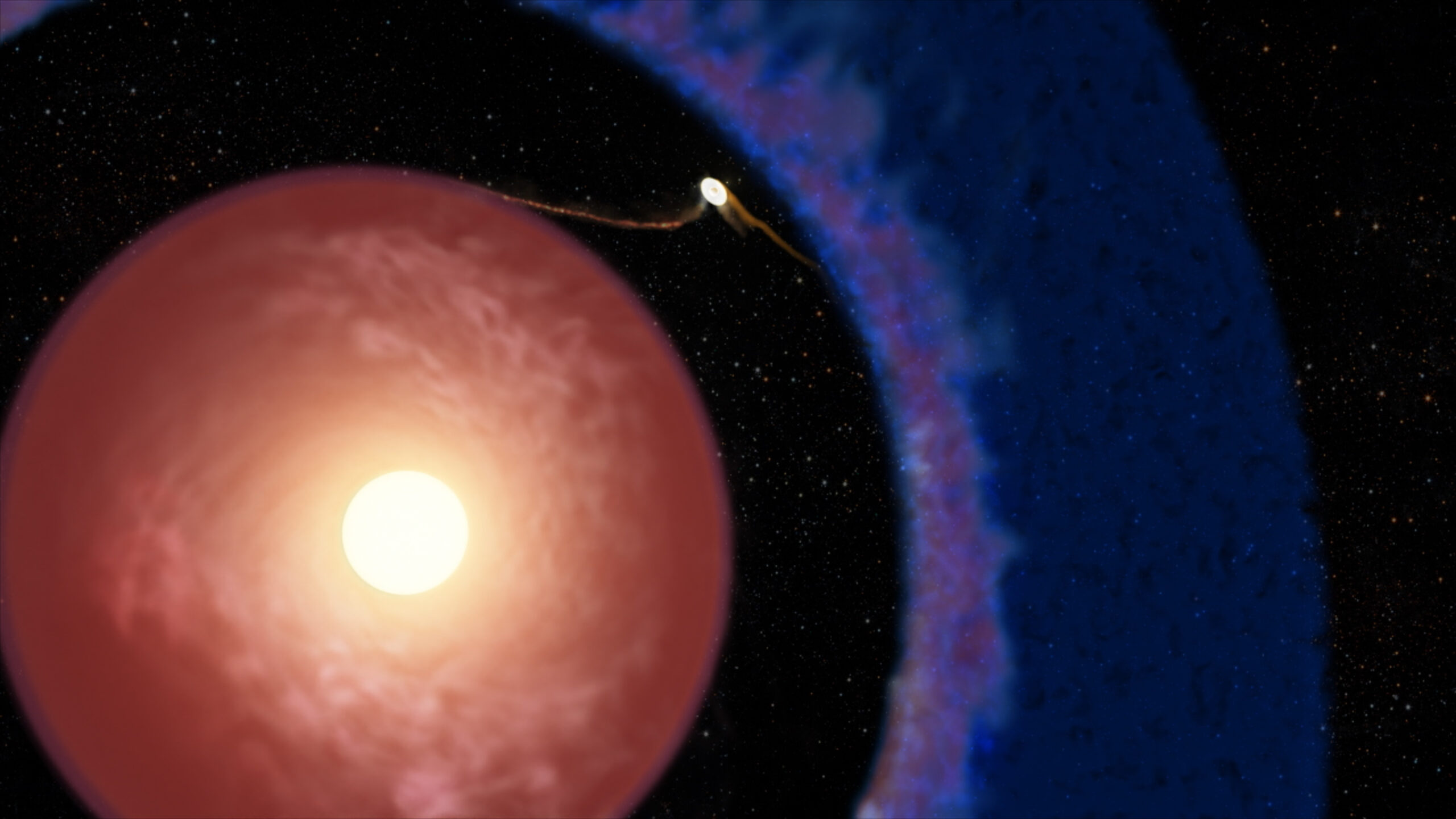
The Solar System has a history of billions of years, while planets in other star systems are much younger. Astronomers have recently confirmed in a study that the youngest known exoplanet to date is less than 1 million years old, making it a small infant in the universe.
According to the National Aeronautics and Space Administration (NASA) of the United States, this young planet, named Elias 2-24 b, orbits the parent star Elias 2-24 at a distance of about 450 light-years from Earth.
Elias 2-24 b is a giant planet with a mass similar to Jupiter, actively drawing in material from the gas and dust disk surrounding Elias 2-24, currently in the earliest stage of planet formation.
The primary author of this study, doctoral student Andrea Bernardi from Diego Portales University in Chile, stated, “This is the youngest planet detected so far because it is still actively accreting material from its surroundings, allowing us to observe a phase of planet formation that is rarely directly observed.”
Young stars are typically surrounded by disk structures formed by gas and dust, known as a protoplanetary disk. Over time, the material in the protoplanetary disk gathers and forms planets, with Elias 2-24 b being a young planet still growing within its protoplanetary disk.
In recent years, the Atacama Large Millimeter/submillimeter Array (ALMA) in Chile has captured several prominent protoplanetary disks, revealing circular structures and dark gaps in the surrounding material. Many astronomers speculate that these gaps are “carved out” by forming planets, but direct evidence was lacking until now.
Now, Elias 2-24 b provides such evidence. Bernardi stated, “We can now more confidently link the appearance of these gaps to the presence of planets. This discovery provides direct evidence that planet formation within the disk can produce these structures.”
Another author of the study, Professor Lucas Cieza from Diego Portales University, noted, “In a sense, we are observing a system similar to our own planetary system but in an earlier stage.”
He added, “Because our solar system is billions of years old, we can only reconstruct how it formed. Systems like Elias 2-24 b allow us to study the ongoing processes.”
In 2018, Professor Alice Zurlo and other researchers from the university first observed Elias 2-24 b using the W. M. Keck Observatory in Hawaii, but the signal was unclear, and it was not confirmed as a planet at that time.
Years later, Bernardi retrieved the archived data from the Keck Observatory Archive and used new techniques to analyze it. The Keck Observatory Archive, a NASA-funded collaboration, preserves all observational data from the observatory.
Through analysis, Bernardi identified a continuous signal of planet formation. Subsequent observations in 2020 from the Keck Observatory, the Very Large Telescope of the European Southern Observatory, and supporting evidence from ALMA ultimately confirmed Elias 2-24 b as a planet.
John O’Meara, Chief Scientist of the Keck Observatory, noted that astronomical observational data can be retained for a long time. New technologies, improved models, and re-evaluation of old data can lead to extraordinary scientific achievements.
The research findings were published on September 16 in “The Astrophysical Journal Letters.”