
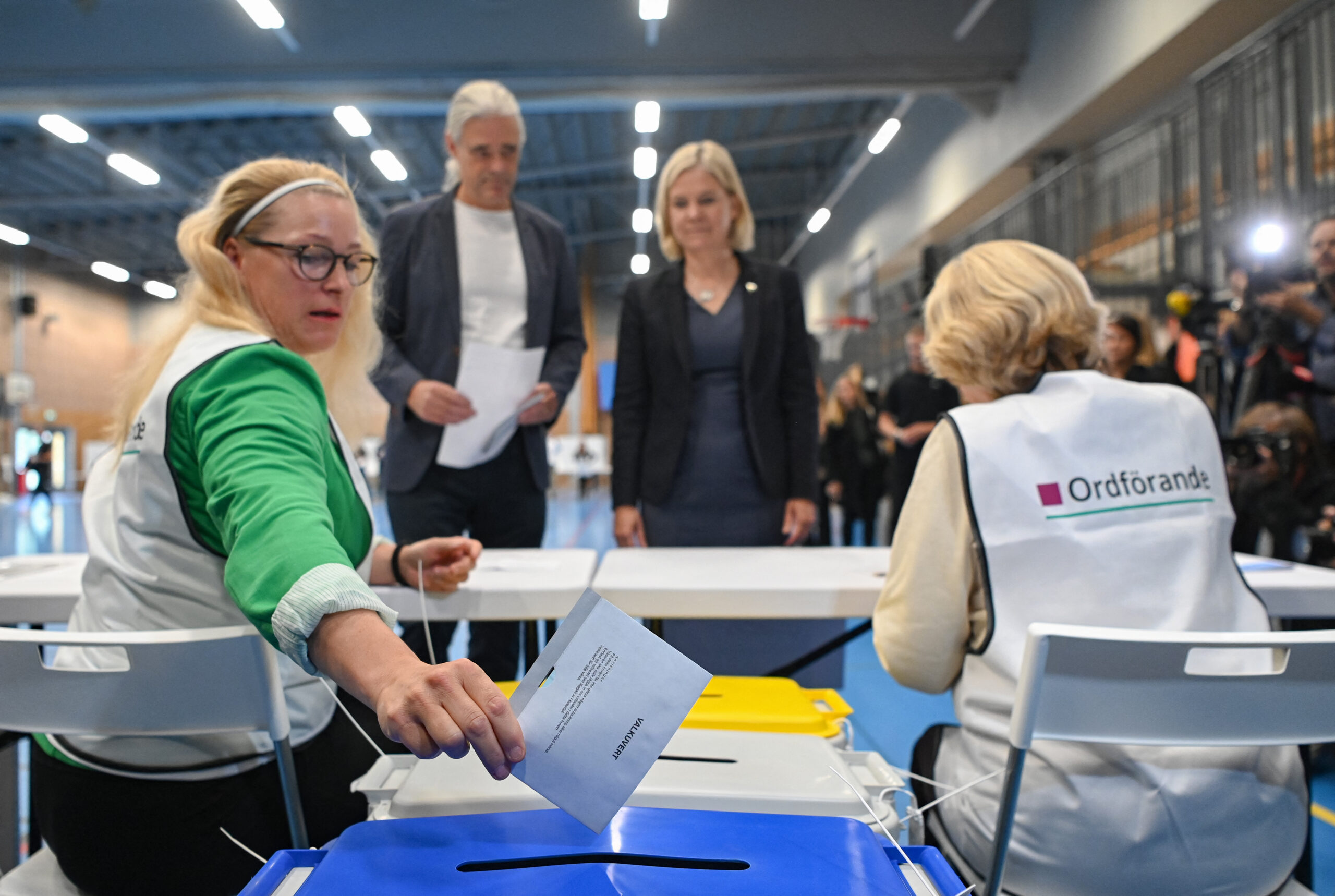
Sweden held parliamentary elections on Sunday (September 13), a fiercely contested election that could reshape the country’s political landscape. The election results may either see the far-right party entering the government for the first time or the left-wing opposition returning to power.
According to NBC News, the election will select 349 members of the Swedish parliament. Approximately 8 million people are eligible to vote out of Sweden’s population of around 10.6 million. Sweden has historically maintained a voter turnout of over 80%.
The election is primarily a showdown between the right-wing camp led by the current Prime Minister and leader of the Moderate Party, Ulf Kristersson, and the center-left camp led by former Prime Minister and leader of the Social Democratic Party, Magdalena Andersson.
Recent polls this week have shown the center-left camp maintaining a lead leading up to the election, but the gap has significantly narrowed in the final stages of the campaign, indicating a possible change in government.
The four-party coalition of the right-wing camp, which includes the far-right Sweden Democrats, is a focal point of the election. In the 2022 election, the Sweden Democrats gained around 20.5% of the vote and secured 73 parliamentary seats, making them a significant force second only to the Moderate Party within the right-wing camp.
In April this year, Kristersson further stated that if the right-wing camp regains power, he is willing to allow the Sweden Democrats to officially enter the government and take on cabinet positions. This would be the first direct involvement of the party in the central government of Sweden since its establishment.
Voter Stefan Larsen told Reuters, “Social welfare or the welfare system is one of the issues I care about. Tax increases or decreases are also crucial issues, as well as the education system. In fact, I believe these are the most important issues.”
20-year-old student Susanne Cherment told Reuters, “This is my first time voting, so the act itself is very important. And because I am young, growing up in this democratic atmosphere, what’s important to me is feeling that I have fulfilled my responsibilities; if I want to make a change, I have the ability to make a change. I also hope that other young people can hold onto this hope: as long as we raise our voices, the situation will improve.”
In recent years, the Kristersson government has significantly tightened immigration policies and strengthened efforts to combat organized crime. The right-wing camp believes that these tough policies have been effective, leading to a reduction in gang violence and illegal immigration issues. The Sweden Democrats advocate for further restrictions on immigration and require immigrants to better integrate into Swedish society.
Andersson leads the Social Democratic Party and hopes to regain power.
Regardless of which camp ultimately emerges victorious, this election has garnered significant attention across Europe. If the Sweden Democrats officially enter the government, it would signify the far-right party with a history of political marginalization moving further into the core of Swedish politics and potentially becoming another significant indicator of the continued growth of far-right parties in Europe. Previously, the Alternative for Germany (AfD) achieved a historic landslide victory in the Saxony-Anhalt state parliament elections on September 6, 2026.
Voting stations in Sweden opened at 8 a.m. local time (2 a.m. Eastern Time); voting will close at 8 p.m. (2 p.m. Eastern Time), followed by the announcement of exit poll results.