
New York State Assembly’s “Task Force on New Americans” released its annual report for the year 2026 on September 1, detailing the immigrant population, employment, and economic conditions in the state. According to the data, the population of foreign-born residents from Mainland China ranks second among the immigrant population in New York State. In New York City, the first-generation Chinese immigrants from Mainland China, Hong Kong, and Taiwan totaling around 400,000 have become the largest foreign-born group in the city.
The report highlighted that changes in federal policies are impacting immigrant communities, with approximately 730,000 legally residing non-citizens potentially losing coverage under New York State’s Essential Plan medical insurance program. Additionally, about 300,000 households are at risk of losing some or all of their SNAP (food stamps) benefits.
The State Assembly report primarily utilized data from the 2024 American Community Survey (ACS) by the U.S. Census Bureau. There are a total of 4,621,382 foreign-born residents in New York State, accounting for 23.3% of the state’s population, with nearly 60% having naturalized as American citizens.
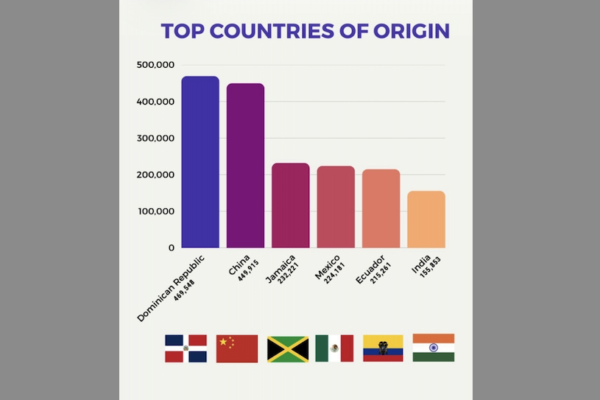
By country of birth, the Dominican Republic has the highest number of individuals born there, with 469,548 people, followed closely by 449,915 individuals born in Mainland China, ranking second, with a difference of only about 20,000 people. The subsequent rankings include Jamaica, Mexico, Ecuador, and India.
When focusing on New York City, the scale of the Chinese immigrant population becomes more prominent. According to the “Newest New Yorkers 2026” released by the City Planning Department, the first-generation Chinese immigrants from Mainland China, Hong Kong, and Taiwan total around 400,000, surpassing those born in the Dominican Republic, becoming the largest foreign-born group in New York City.
These two sets of statistics have different scopes: the 449,915 individuals from Mainland China in the State Assembly report represent the total number of individuals from Mainland China in New York State, while the approximately 400,000 data from the City Planning Department includes first-generation Chinese immigrants born in Mainland China, Hong Kong, and Taiwan in New York City.
The report emphasizes that immigrants are a crucial part of New York State’s workforce and economy. Among foreign-born residents in the state, 72% are of working age. Immigrants own approximately 316,500 businesses, contributing over $31.3 billion in state and local taxes annually, and $43.5 billion in federal taxes, totaling more than $74.8 billion.
Some key industries particularly rely on immigrants. The report states that immigrants make up 30.6% of nurses in the New York area, 47.4% of the childcare workforce in the New York metropolitan area, and 23.2% of recent homebuyers.
However, immigrants also face language and employment barriers. Among foreign-born residents aged 5 and older, 47% have limited English proficiency, and 15.4% live below the poverty line. Among foreign-born workers with college degrees, 32.7% are employed in jobs that do not require a college education.
Another focus of the report is the impact of changes in federal policies on welfare. Around 730,000 legally residing non-citizens may lose coverage under New York State’s Essential Plan, and about 300,000 households are at risk of losing some or all of their SNAP benefits.
In response, the Task Force proposed expanding state-level food assistance to cover 41,000 refugees, asylees, and parolees newly excluded from SNAP eligibility, as well as 65,000 non-citizen families with children.
The state budget for this year will also increase immigration legal services funding by $10 million, reaching a total of $74.2 million, allocate $2.6 million for language services, $50 million for housing voucher programs, and $7 million for refugee services.
The Task Force further advocates for expanding state-level housing assistance and adult English language and vocational training, and proposes that individuals meeting professional qualifications should not be denied state and local occupational or business licenses solely based on citizenship or immigration status.