
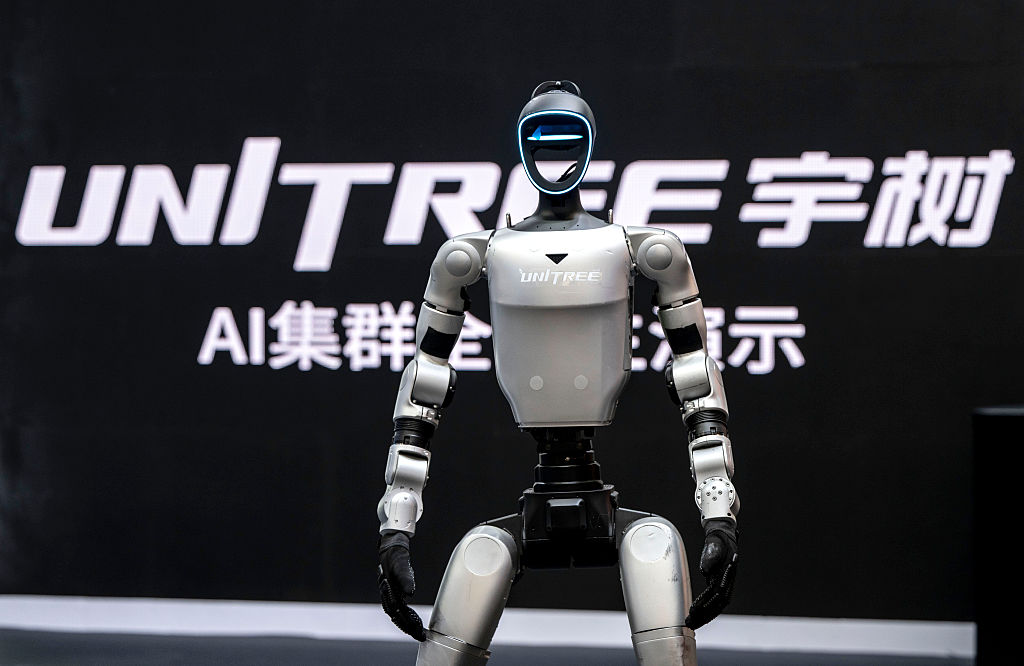
Under the support of the Chinese Communist Party (CCP), a large number of companies in the robotics industry have emerged rapidly in China, leading to intense competition within the sector. Wang Chenglu, the former technology veteran of Huawei and current CEO of DeepOpen Technology, revealed that 76% of domestically produced robots in China still rely on overseas ROS systems, with an autonomous rate of less than 40% for core algorithms.
According to a report published by Phoenix Net on August 30th, Wang Chenglu believes that the reliance of domestically produced robots on foreign technology is not just a technical choice issue, but also a matter concerning the foundation of the industry.
He further explained that although ROS is called Robot OS, it “is not a complete operating system; it needs to run on the Linux kernel, so it is a middleware.” In other words, what many domestic robot enterprises use is just a middleware that runs on top of other operating systems. The foundation of the entire technology stack is not in their own hands.
Wang Chenglu bluntly stated that this kind of dependence leads to “fragmentation of technical routes, each company has its own set, and they are not interoperable.” Each robot company builds on top of ROS, but the repetitive work cannot form synergy.
Public information shows that Wang Chenglu graduated with a doctorate from Harbin Institute of Technology in 1998 and joined Huawei, where he served as the president of the Huawei core network product line and the president of the Central Software Institute, and he was instrumental in the development of the Harmony operating system. In May 2022, after working at Huawei for 24 years, he left his position as president of the Consumer BG Software Department at Huawei.
Currently, the CCP is attempting to compete with the United States for dominance in the global market for robots and the artificial intelligence (AI) models that drive these robots. With relevant policy support, the number of Chinese robot enterprises has more than tripled from 2020 to 2024.
Although robots can now perform eye-catching demonstrations such as dancing, kung fu, and boxing, several industry insiders have mentioned that robots still face issues such as insufficient precision, difficulty in long-term stability of operation, and a significant decrease in success rate when changing scenarios.
Wang Xingxing, the founder of Uskr Technology, admitted during the 2026 World Robotics Conference on August 20 that currently, even if robots can complete some simple tasks, their efficiency is still lower than that of human labor. After thorough training in a fixed scenario, the success rate of tasks can reach close to 100%, but once the operating item is changed or the environment is slightly altered, the success rate drops significantly. Due to overall inefficiency and capability shortcomings, Uskr Technology has not yet undertaken large-scale promotion.
Xie Shaofeng, chairman of the Open Atomic Open Source Foundation, stated that the industry’s technical routes are fragmented, and standards are lacking. The sensing configurations, motion spaces, and data structures of different manufacturers are not unified, leading companies to repeatedly perform basic adaptations and engineering verifications – the high-cost data collected is also difficult to reuse across devices and tasks.
Some experts have expressed skepticism about the application scenarios of humanoid robots. Dr. Harold Soh of the National University of Singapore told the BBC that it will take several more years for robots to effectively enter home environments. Companies still need to address issues such as battery life, privacy protection, and reliability.