
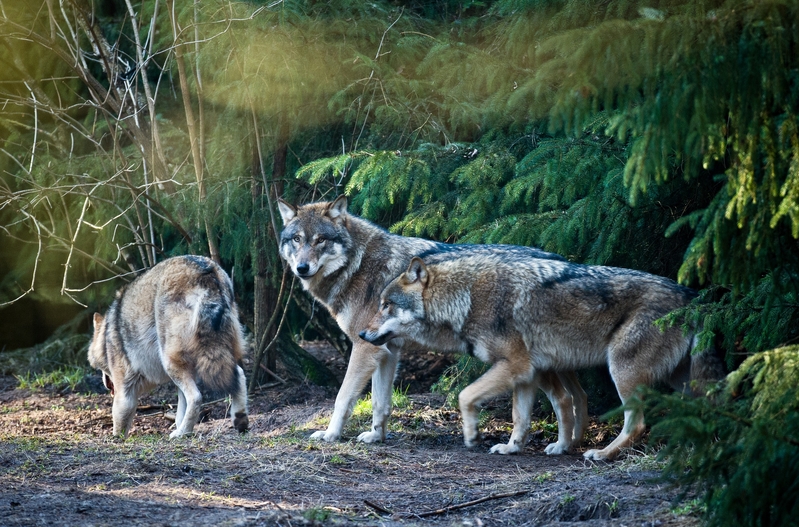
In the depths of the mountains, Marcos Rodríguez Pantoja lived barefoot and half-naked with a pack of wolves, untouched by cold and loneliness. However, the coldness of the human world made it difficult for him to ever adapt.
This month, the Spanish “wolf boy” Marcos passed away at the age of 80. His legendary life story is nothing short of incredible.
Marcos was born in 1946 in a small village called Añora in southern Spain. His biological mother tragically passed away when he was 3 years old, and his stepmother abused him while his father remained distant.
Around the age of 7, due to extreme poverty, his father sold him to a farmer. The man took him to the Sierra Morena mountain range to work for an elderly shepherd. The old man took care of Marcos, keeping him warm with animal pelts, teaching him to milk goats, and showing him how to catch wild rabbits.
Soon after, the old shepherd passed away, leaving Marcos to survive on his own with the skills he had learned. Having endured years of abuse from his stepmother, he preferred the solitary life in the mountains and never attempted to leave. Whenever he heard human voices, he would hide, and it wasn’t until he was 19 years old that the Civil Guard found him.
In an interview with the BBC many years ago, Marcos explained how he formed a special bond with a group of wolves.
He said, “One day, I walked into a cave and started playing with wolf cubs living there, and eventually fell asleep. Later, the mother wolf brought back food for them, and I woke up.”
“It saw me and stared at me fiercely. The mother wolf began tearing the meat into pieces. A wolf cub approached me, and I tried to take its food because I was hungry too. The mother wolf swiped at me with her claws, and I backed off.”
“After feeding the cubs, she tossed a piece of meat at me. I didn’t want to touch it, thinking it was going to attack me, but it nudged the meat towards me with its nose, and I took it and ate. I thought it was going to bite me, but it extended its tongue and started licking me. Since then, I became part of their family.”
He said, “I was doing well then. I didn’t know about money, but I never lacked food.”
“If I wanted fish, I would go fishing in the river. If I wanted to eat rabbits, I would catch one. If I wanted deer, I would call for my parents, the wolf pack. I would howl, hide in the river, and the wolves would drive the deer towards me.”
“The animals guided me on what to eat. Whatever they ate, I ate too. Wild boars ate tubers buried in the ground. They found these tubers by smell. When they dug around in the soil searching, I would throw a stone at them, making them run away, and then I would take the tubers.”
Marcos revealed that these relationships dispelled his loneliness. The only time he felt lonely was when he couldn’t hear the animals. During those times, he would mimic their calls. Even as he grew older, he could still imitate the sounds of wolves, deer, foxes, eagles, and other animals.
“Once they responded, I could sleep peacefully, knowing they hadn’t abandoned me.”
Marcos always told others that the happiest time of his life was the days he spent living with the wolves. He enjoyed the tranquility of the mountains and the simplicity of being with animals.
However, this way of life abruptly ended when he was 19. One day, the Civil Guard found Marcos wrapped in deer skins, with unkempt hair, and forcibly brought him to a village at the foot of the mountains.
His father was brought to identify him.
“Seeing him, I felt nothing. He only asked me one question: ‘Where is your shirt?’ as if I would still be wearing the same clothes I left in!”
As Marcos’ father showed no interest in taking him back home, the police left him in a public square.
“I didn’t know where to go. I just wanted to run back to the mountains,” he said.
What unsettled Marcos the most was the noise and hustle of human settlements.
“I couldn’t stand the loud noises… the cars… and the crowds moving back and forth like ants. At least ants move in the same direction, while people scuttle around aimlessly! I was afraid to even cross the street.”
Returning to the human world and relearning how to be a human being was a long journey. Marcos had to relearn language, how to walk upright, and how to sleep in a bed.
When faced with a bowl of soup for the first time, he was at a loss. He carefully examined it, cupped his hand, and then plunged it into the bowl. As the hot soup touched his hand, he was startled, causing the bowl to shatter, spilling everywhere.
Initially, Marcos lived with a priest, then later with nuns in Madrid. The nuns taught him language and social norms.
“They taught me how to eat properly and placed a piece of wood on my back to help me walk with an upright posture.”
People who first met Marcos remember him walking with a hunched back and bow legs like a monkey.
Marcos recalled that he spent some time in a wheelchair because a doctor had removed all the calluses from his feet, making it impossible for him to walk at the time.
Leaving the nuns, Marcos drifted between various labor-intensive jobs, even briefly serving in the military.
Those who knew him described him as simple and kind but somewhat childish, completely lacking in understanding of social and social life. He struggled with socializing, his Spanish language skills were not fluent, and people often took advantage of his innocence, deceiving and mistreating him. Marcos never fully integrated into society.
He led a miserable life in Malaga until he met a retired police officer who invited him to live in a small village called Rante. Here, he received acceptance and care from some villagers, feeling the warmth of humanity, and remained in Rante until his passing.
He once told a reporter from The Guardian, “The majority of my life was always difficult when interacting with people.”
“People say one thing but think another. Animals don’t do that.”
He always found it difficult to connect with people, feeling confused by their ignorance and unable to communicate.
“I endured humiliation constantly. In crowds, I learned to hate and feel embarrassed.”
That was in 2018 when he was in his seventies, still unable to look directly into the eyes of the person he was speaking with, appearing shy and reserved, always anticipating a contemptuous look.
It is not surprising that besides facing social rejection, people had never believed Marcos’s story of living in the mountains with wolves for many years. They simply saw him as a fool or a drunkard.
“At first, when I heard this story, I didn’t believe him. I thought, ‘This can’t be true,'” said Gabriel Janer Manila, a Spanish university professor, anthropologist, and writer.
“But his account was consistent, detailed, and he repeated the same phrases every time I asked. So I secretly decided that I had to get to the bottom of this story.”
Manila conducted a six-month extensive interview with Marcos in the 1970s, visited the locations Marcos mentioned, and spoke with people he referred to.
“I interviewed people who had interacted with him when he was found, those who sheltered him, the staff who first bathed him, and the seminary students who cared for him… All these people emphasized his wild nature, his ignorance of society, and his inability to follow the rules. These descriptions matched what Marcos told me.”
It was through Manila that Marcos’s story became widely known. Manila wrote a doctoral thesis on the Marcos case and later published a novel based on Marcos’s life story.
In 2010, a movie based on Marcos’s life was released. Finally, many people started to believe in the legendary “wolf boy” story.
Suddenly, Marcos gained fame, attracting reporters and fans who wanted to talk to him. People wrote to him, some seeking to understand him, others seeking his advice, and some expressing a desire to take care of him.
“People come to see me from time to time. Some think I am wealthy and try to take advantage of me. I don’t even have a penny!”
He revealed that a woman once visited him and professed her love for him. “She offered herself to me and said we should do business together. I guess she thought I made a lot of money from that movie.”
Marcos couldn’t fathom why his story had been ignored for decades but suddenly gained international attention 40 years after Manila first wrote about it.
“In the beginning, they didn’t want to hear a single word I said. Now, they keep wanting to listen. What do they really want?”
For Marcos, this sudden surge of admiration was both baffling and hurtful, difficult to understand.