
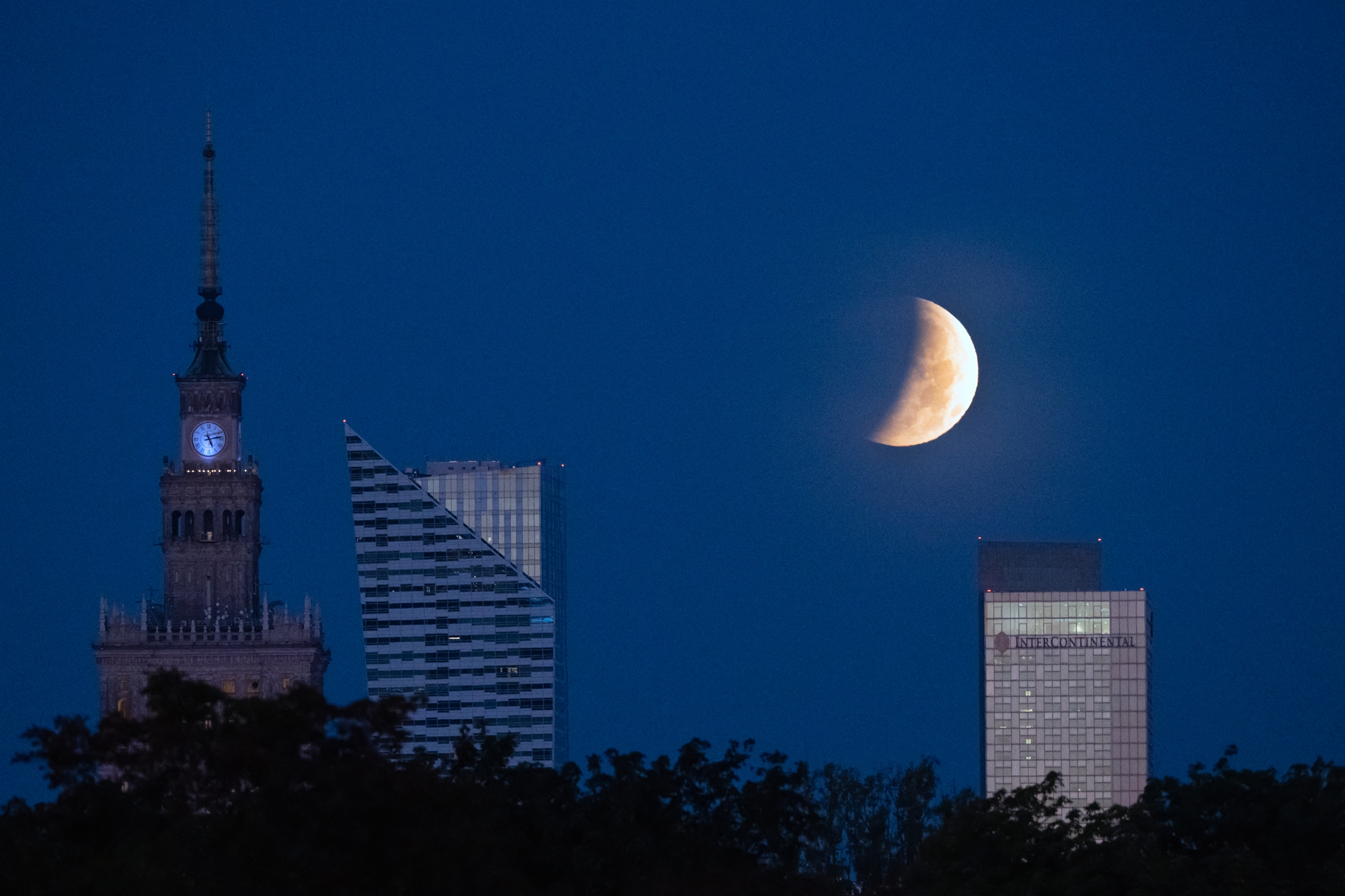
In August 2026, the Sturgeon Moon reached its full moon moment at 12:18 AM Eastern Time on the 28th. However, this full moon was not ordinary as it triggered an extremely rare “partial lunar eclipse” in the western hemisphere.
Although this eclipse was technically a “partial lunar eclipse,” the eclipse magnitude reached between 0.93 to 0.96. This means that over 93% of the moon’s diameter would slip into Earth’s darkest shadow. At the maximum eclipse moment, the entire full moon was almost completely engulfed, leaving only a narrow strip of brightness. Due to the sunlight refracted by Earth’s atmosphere, the lunar surface did not turn completely black but instead took on a striking copper-red, rust-colored, or dark orange hue, creating a visual effect closely resembling a “total lunar eclipse blood moon,” hence being referred to as an “almost blood moon” by stargazers.
According to astronomical data, this celestial event belongs to the “Saros 138” series. What is remarkable is that this is the deepest and most extreme partial lunar eclipse that the series can produce in its evolving cycle of 1460 years. The next lunar eclipse in this cycle, set for 2044, will officially evolve into a total lunar eclipse.
The full moon in August, traditionally known as the “Sturgeon Moon” in North America, symbolizes maturity and harvest in late summer and early fall. As the final full moon of the summer this year, it painted a magnificent color-changing spectacle that raced against dawn, providing a beautiful conclusion to the night sky of this summer.