
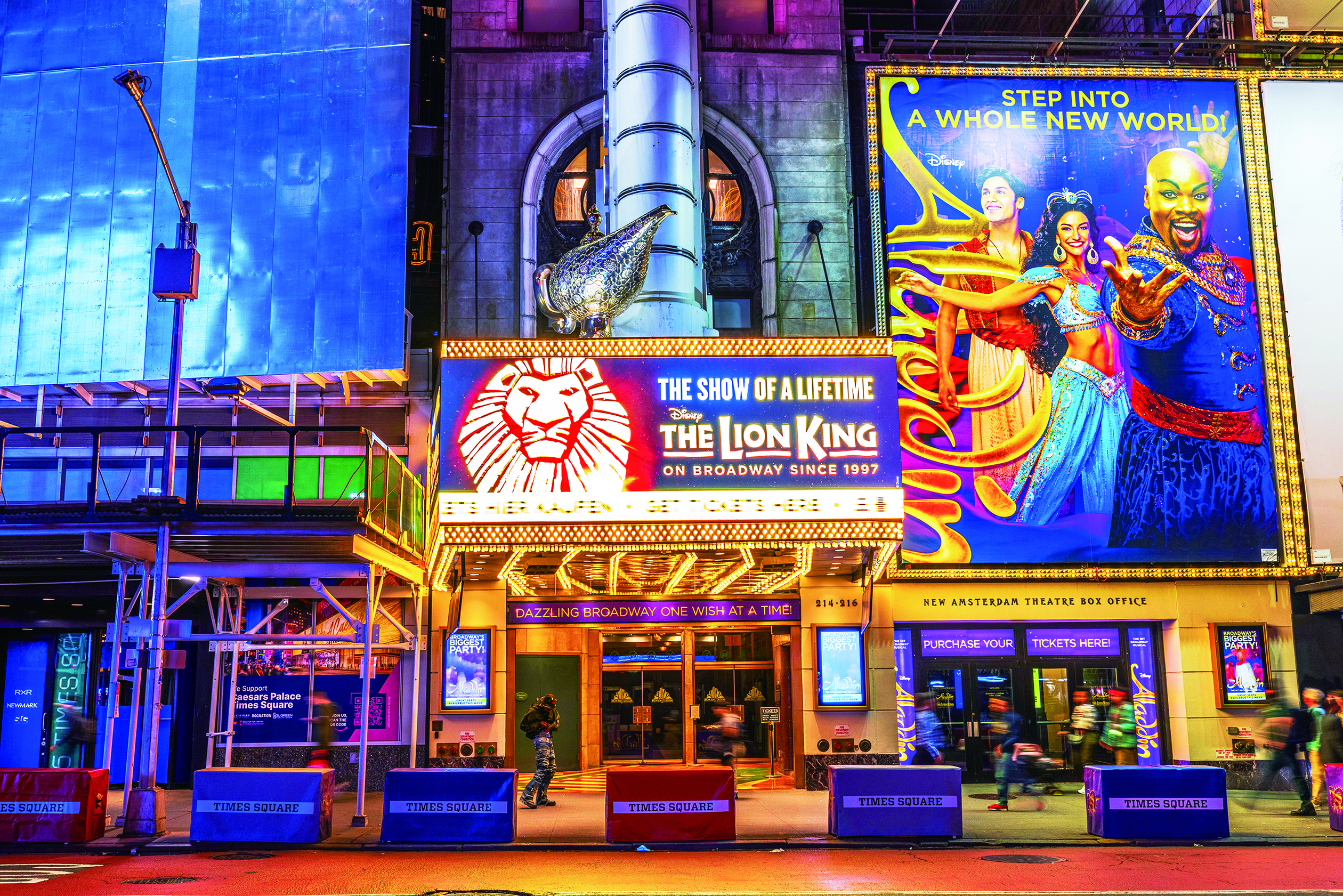
If New York is the city that never sleeps, then the Theater District is its perpetual beating heart. Spanning roughly from West 40th Street to West 54th Street, between 6th and 8th Avenues, this area around Times Square is home to 41 Broadway theaters with over 500 seats each, making it the highest temple of commercial drama and musicals worldwide.
During the day, the district bustles with commuters and eager tourists, but it truly comes alive at night. Giant electronic billboards turn the sky into daylight, and colorful neon signs flicker on the facades of century-old buildings. The most enchanting sight is the crowd winding under the marquees every night, eagerly awaiting entry, with people rubbing shoulders on the bustling streets, their eyes sparkling with anticipation for the upcoming performances.
As the theater lights dim and the noise fades away, the red velvet curtains slowly rise – at that moment, the burdens of the real world are momentarily left outside.
Broadway stages are like portals to multiple universes, immersively realizing dream experiences through various mechanics and light magic. In “Aladdin,” the vibrant sets and flying carpets capture the purest wonder of fairy tales; in “The Lion King,” lifelike giant animal puppets accompanied by powerful African chants turn the theater into a vibrant savannah; “Harry Potter and the Cursed Child” and “Wicked” cleverly use invisible rigging, fog, and dazzling light effects, spreading magical sparks directly to the audience’s fingertips.
This unparalleled charm goes beyond fantasy, delving into the splendid collision of literature and history under the spotlight. “Hamilton” visualizes time with a rotating stage, reconstructing the history of America with fervor and pathos; “The Great Gatsby” uses flying gold foil to embody the extravagance and disillusionment of the 1920s American dream into a flowing feast. These productions, driven by powerful artistic tension created through sound, light, and shadow, firmly grasp the audience’s hearts. The most moving aspect of musical theater is seeing oneself reflected in others’ stories.
Looking back at the origins of this theater mecca, Broadway didn’t start with its current splendor. As early as 1750, the first theater in New York quietly opened in downtown, a modest space accommodating approximately 280 people.
With the population boom and commercial prosperity in mid-19th-century Manhattan, downtown’s land values soared, prompting theaters to embark on a long northward migration. In the 1840s, the theater district took shape at the intersection of Broadway and Prince Street; by the 1870s, the theatrical center shifted further north to Union Square on Broadway and 14th Street. Though not yet the bustling hub of New York at that time, it was quietly accumulating energy for the impending explosion.
The pivotal turning point that solidified today’s Theater District occurred in the early 20th century. With the opening of subway networks, theaters once again followed the tide of the times and migrated north to the relatively affordable Times Square surroundings. The 1920s and 1930s saw an unprecedented building boom with significant capital inflow, giving rise to sumptuous theaters springing up within several blocks. By the 1940s, the current Theater District as we know it today had firmly established its scale, elevating niche downtown stages into an irreplaceable global commercial arts hub.
Beneath this vibrant façade, the backbone of the entire Broadway operation is supported by the three major theater groups: The Shubert Organization, The Nederlander Organization, and Jujamcyn Theaters (now under ATG Entertainment).
Among them, the oldest and most influential is The Shubert Organization. In the early 20th century, the Shubert brothers from Russia – Sam, Lee, and Jacob – with sharp business acumen and daring, built a vast theater empire in New York, breaking the theatrical monopoly of the time. Today, they own 17 theaters on Broadway, rightfully dubbed as the “largest landlord on Broadway.”
Currently, The Nederlander Organization controls nine top-tier theaters on Broadway (including venues staging “The Lion King” and “Wicked”). They have not only made great strides in theater management but also firmly hold Broadway’s ticketing lifeline through their Broadway Direct ticketing system.
Jujamcyn Theaters owns five theaters, which merged with the UK’s largest commercial theater operator, ATG (Ambassador Theatre Group), in 2023 to form ATG Entertainment. This merger endowed these five New York theaters with stronger international capital and cross-border production resources. “Moulin Rouge! The Musical” at Al Hirschfeld Theatre, one of its venues, will conclude its seven-year run on August 30 this year.
Taking over the baton of this golden theater on March 30 next year will be the heartwarming and distinctly British new musical “Paddington.” The iconic bear with a red hat and old suitcase swiftly opens the doors of Broadway thanks to the strategic showcase following Jujamcyn’s alliance with ATG.
In the Theater District, if theaters are the stage for dreams, then restaurants are the living rooms where dreamers gather. Among all Broadway restaurants, none can match the historical status of Sardi’s. This legendary restaurant, known as the “unofficial club of Broadway,” is undergoing a significant historical transition. Located on West 44th Street, this iconic restaurant will celebrate its centenary this year.
Sardi’s is best known for its iconic burgundy leather booths and over 1,000 celebrity caricatures adorning its walls. Whether from the golden age of legends or contemporary theater newcomers, having a custom caricature on Sardi’s walls signifies the highest recognition in the heart of Broadway. Even the highest honor in theater, the Tony Awards, was conceived and born on a table at Sardi’s.
Time flies, and this old establishment that has witnessed countless joys and sorrows is dimming its lights temporarily. Sardi’s closed for a comprehensive renovation on June 24 this year and is set to reopen in November. Meanwhile, there has been a change in ownership. After leading Sardi’s for 33 years, current owner Max Klimavicius announced his departure. His career path is as dramatic as the theater; starting as a busboy in Sardi’s kitchen, he eventually rose to become the proprietor of this century-old establishment.
Now, he has sold this weighty historical asset to the building’s owner – The Shubert Organization. The restaurant’s space layout will remain unchanged, and its name will stay the same, arousing anticipation among theater enthusiasts for the reopening day.
As long as there are stories to be told, and people yearn to find resonance in the dark, the lights of Broadway will not go out. Whether it’s the enchanting fantasy musicals, the commercial giants driving box office success, the century-old memories of Shubert Alley, or the rejuvenating Sardi’s restaurant, they together weave a vast, complex yet incredibly charming ecosystem. In the Theater District, art and commerce achieve the most exquisite balance, blending the weight of history with the innovation of modern times. ◇