
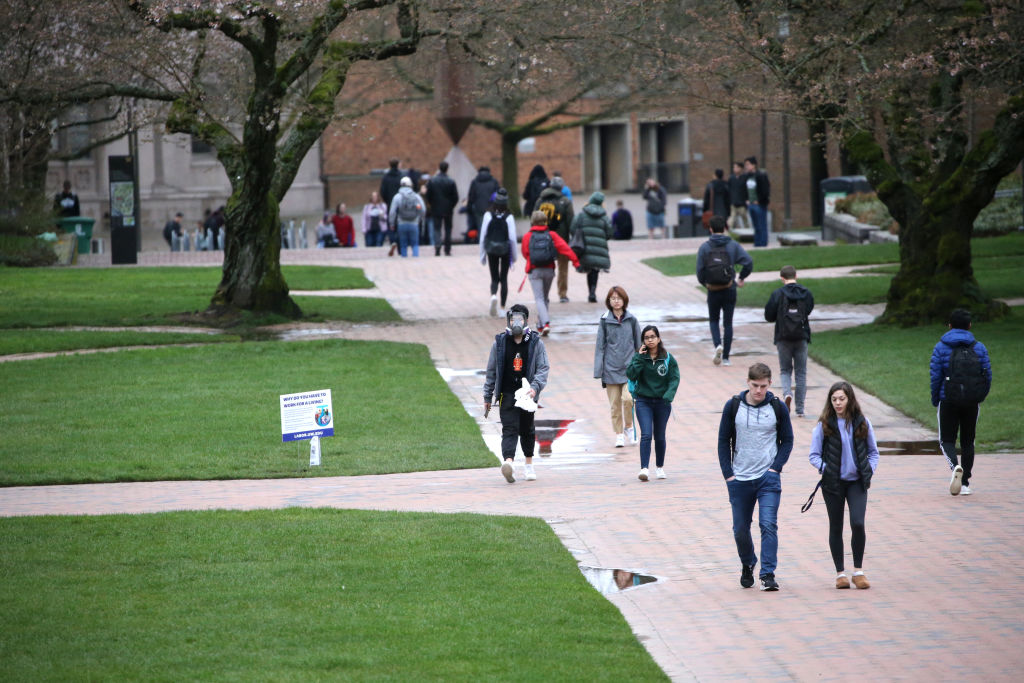
In the United States, the idea of completing a bachelor’s degree in four years is being challenged by an increasing number of universities. A new trend of reducing the required credits for graduation and obtaining a bachelor’s degree in as little as three years is rapidly gaining traction. Traditionally, a bachelor’s degree typically requires 120 credits, but the new programs require as few as around 90 credits, equivalent to completing one year less of study. For students, this not only means saving on tuition for one year but also the opportunity to enter the workforce earlier.
According to a report from the Associated Press, 34-year-old Giles Sims, who was previously a web developer, faced rejections in job searches due to the lack of a university degree after losing his job. However, with a wife and a widowed mother to support, he found that four years of study were too long for him. Consequently, he enrolled in a 90-credit Applied Science bachelor’s program at Ensign College in Salt Lake City.
As of the spring of this year, at least one institution in 26 states in the U.S. offers a three-year bachelor’s program with reduced credits. A study by the non-profit research organization RAND shows that as of May, nearly 120 such programs have been publicly announced nationwide.
Supporters argue that this move is a response to the skyrocketing costs of higher education, particularly suitable for working adults who have families to support or wish to re-enter the workforce quickly.
Nonetheless, concerns have arisen: will students receive an adequate education with fewer credits? Will employers recognize and value these degrees? Can graduates apply for graduate school programs? For professions like teaching or accounting that require state licensure, are 90 credits sufficient?
In the past, there were accelerated bachelor’s programs in the U.S. that allowed students to graduate in three years by taking summer classes, transferring credits, or compressing a semester into 5 to 10 weeks, but the total credit requirements for graduation remained unchanged.
The latest round of three-year bachelor’s programs is distinct in that they directly reduce the required credits, with the minimum being around 90 credits, approximately a quarter less than the traditional 120-credit bachelor’s programs. A significant turning point for this model occurred in 2023.
The Northwest Commission on Colleges and Universities (NWCCU) approved Brigham Young University-Idaho and Ensign College to pilot the three-year reduced credit bachelor’s programs. NWCCU’s official documents indicate that these pilot programs consist of 90 to 95 semester credits.
In 2025, NWCCU removed the pilot designation from the programs at these two schools and allowed other institutions to apply for offering reduced credit bachelor’s programs centered on learning outcomes rather than traditional credits.
Currently, about three-quarters of the reduced credit bachelor’s programs are offered by private non-profit institutions, many of which can be completed online. The most common fields are marketing, management, computer science, and information technology. These schools typically focus on cutting elective courses. However, disciplines like engineering and teacher education are harder to compress due to additional requirements for professional courses, internships, or licenses. The RAND study indicates that there are currently only six reduced credit bachelor’s programs in the field of teacher education.
Jill Cohen, 42, supports the concept of earning a three-year degree that trims credits and eliminates unrelated electives. Residing on a farm in Yoder, Colorado, she made a career shift to teaching after leaving a job in life insurance sales following a serious accident.
She is now teaching English at a high school while pursuing a three-year Education bachelor’s program through the “Grow Your Own” initiative at Indiana Wesleyan University. Such programs are primarily designed to address teacher shortages.
Cohen, who has 12-year-old twins and a variety of animals at home, values the time saved by shortening the program. She straightforwardly explains her preference for this type of curriculum: “Why should I study unrelated electives when I could be learning about the evolution of the English language, which is what I am going to teach?”
Policy researcher Jenna Kramer at RAND is most concerned about professions that require state licensure. For instance, Indiana Wesleyan University, where Cohen studies, states that its education program aligns with Indiana’s teacher licensing requirements, but students from other states need to verify if the courses meet their respective state standards.
Accounting presents another typical example. Wesley Hardy, 22, is pursuing a three-year Accounting bachelor’s program at Ensign College. He aims to enter the workforce a year earlier but may still face credit requirements if he plans to become a Certified Public Accountant (CPA) in the future.
Many states in the U.S. require at least 120 semester credits to sit for the CPA exam, with licensing often necessitating 150 credits. Hence, while a 90-credit bachelor’s program may allow students to graduate earlier, it may not necessarily expedite their progression through all professional hurdles.
Additionally, the RAND study finds that due to the recent introduction of three-year bachelor’s programs, there is no uniformity in graduate school admissions practices for these graduates.
Critics argue that three-year bachelor’s programs may narrow students’ educational scope excessively and create challenges for employers in understanding the distinction between these new degrees and traditional bachelor’s degrees. Moreover, graduates may encounter limitations when applying for graduate programs or face added complexities in professions requiring state licensure.
The American Association of University Professors (AAUP) believes that such programs may devalue the significance of a university degree itself. AAUP Chair Todd Wolfson expressed to the Associated Press, “It’s not innovation; it’s taking shortcuts.”
However, three-year bachelor’s programs are not entirely novel. They are common in countries like the UK, India, France, and Italy, and some universities in the U.S. initially adopted three-year programs during the colonial period, with four-year programs gradually becoming the norm in the 19th century.