
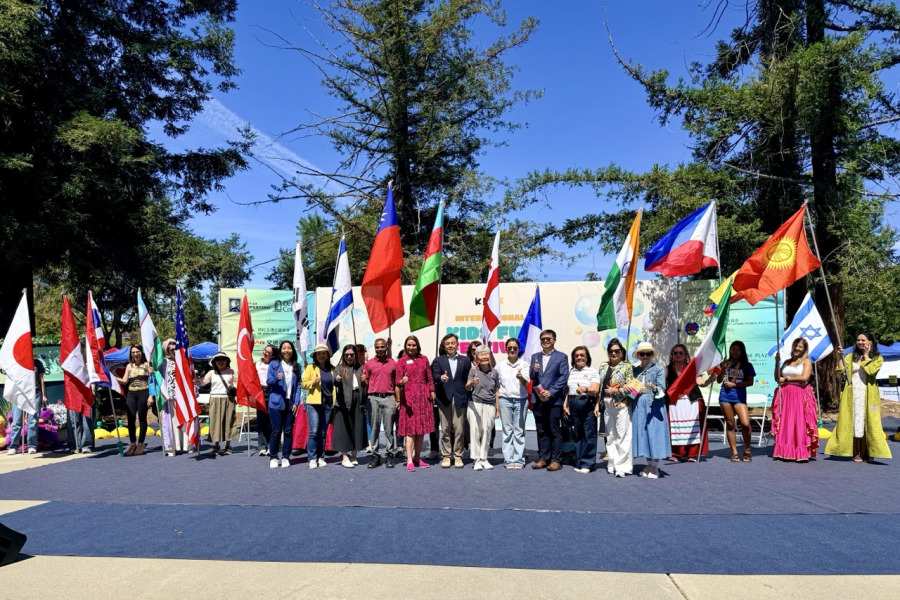
On August 22nd, the 2026 International Kids Fun Festival took place at Cupertino Memorial Park, attracting numerous Bay Area residents. Cultural groups from 20 countries gathered to showcase their diversity through music, dance, crafts, food, and games. One of the highlights of the event was the Taoyuan Elementary School Aboriginal Choir from Wufeng Township, Hsinchu County, Taiwan, who traveled across the sea to participate this year.
The festival, organized by the Taiwan Cultural and Sports Association (TCSA) based in Northern California, celebrated its 16th year. Since its inception in 2010, the Kids Fun Festival has grown to become one of the largest children’s events in the San Francisco Bay Area.
Dr. Fu Hongyu, co-founder and chief consultant of TCSA, mentioned that the festival was initially created to help children growing up in the United States connect with Taiwanese culture and their roots through games, sports, dance, and performances. As the event has expanded over the years, it now serves as a platform for ethnic and cultural exchange.
President of TCSA, Jiang Yuexin, mentioned that the International Village this year expanded to include cultural groups from 20 countries covering Asia, Europe, Central Asia, and South America, providing diverse cultural experiences. She expressed hope for African cultural groups to join in future editions, emphasizing the goal of uniting Silicon Valley’s diverse ethnicities and languages under the common language of love for children and families.
The stage performances were diverse, featuring Bollywood dances, as well as music, dances, and traditional costumes from ethnic groups such as Azerbaijan, Venezuela, Japan, Vietnam, Kyrgyzstan, Thailand, Georgia, Peru, and Scotland.
One of the most anticipated performances featured the Taoyuan Elementary School Aboriginal Choir from Wufeng Township, Hsinchu County, Taiwan. The choir presented songs like “Hand in Hand,” “Dance of Water,” traditional Tayal songs such as “Ritual to the Gods,” and showcased traditional instruments like wooden and bamboo flutes brought from Taiwan.
Fifteen-year-old Tayal student Zhou Chenxi expressed her excitement about her first trip to the United States, having previously participated in events in Singapore, New Zealand, and Japan. She noted that international exchanges broaden perspectives and provide opportunities to showcase courage through competitions, stating she was “very happy to stand on the international stage.”
Additionally, a Tayal cultural booth was set up at the event, offering handmade items like vests, coin purses, tablecloths, backpacks, and straps made from traditional Tayal fabrics. Funds raised through sales would support students traveling to Italy for competitions next year.
Within the International Village, cultural booths from various countries attracted families. The Korean cultural booth named “Chopstick Story” showcased traditional Korean crafts like making wooden chopsticks and lotus lanterns, introducing Korean culture to the attendees.
Participants had the chance to craft wooden chopsticks, emphasizing the interconnectedness of using two chopsticks together, symbolizing connections among people. It was explained that China’s chopsticks are usually longer, Japan’s are sharper, while Korea traditionally used metal or brass chopsticks. However, wooden chopsticks were chosen for the activity due to the ease of crafting at the event.
The American Mazu Temple, a Taiwanese cultural booth, was another popular attraction at the festival, where parents engaged their children in traditional folk activities like “Drilling the Palanquin”.
Andrew Yang, attending the festival for the first time with his family, highlighted how the event broadened his children’s horizons by exposing them to diverse cultures and knowledge beyond the classroom. Introducing his children to Mazu culture, he emphasized the importance of understanding more about Chinese traditions for the next generation, expressing his definite intention to attend again in the future.
The Chinese Historical and Cultural Project (CHCP), a Bay Area Chinese history and culture organization, presented activities on San Jose Chinese immigrant history and the contributions of Chinese Americans to society, using waterbrush calligraphy, tangrams, and “Who Are We?” exhibit boards to engage children and parents.
The organization’s president, Wu Xiuling, spoke about the Five Saints Museum in San Jose, preserving the history of five former Chinatowns in the region and showcasing artifacts left by the early Chinese community residents, aiming to educate more Bay Area residents that Chinese immigrants have long been part of the local community since the mid-19th century.
Starlight Affairs, a group advocating for Tibetan culture through the “Spring of Lhasa” booth, aimed to raise awareness about Tibetan culture and the current situation in Tibet, offering related books and information to visitors interested in or planning trips to Tibet. Visitors were supportive of the cause, with some requesting “Free Tibet” stickers, marking the team’s first valuable opportunity to engage with communities less frequently encountered.
In addition to cultural performances, the festival’s food section featured a variety of Taiwanese and Asian flavors, including shaved ice, braised pork rice, pig’s feet, wheel cakes, sweet potatoes balls, Filipino barbecue, donuts, cotton candy, and more.
The “Ami Kitchen” booth drew long lines for its original and purple sweet potato balls, a favorite among attendees. One visitor noted that her daughter’s love for sweet potato balls led them to start their festival experience with a purchase from the booth.
The game area was equally lively, offering activities like quick eyes, axe throwing, pinball, face painting, goldfish scooping, baseball grid games, ring toss, as well as rides like bumper cars, bounce houses, mini trains, trampolines, pony rides, and animal interaction areas tailored to different age groups to enjoy.