
During World War II, the various types of land-based and carrier-based fighter planes developed and produced by the United States dominated the skies, securing crucial air superiority in the European and Pacific battlefields. Additionally, the United States also developed and produced various types of attack and bombers, which inflicted more devastating blows on enemy forces, playing a larger role in winning the war.
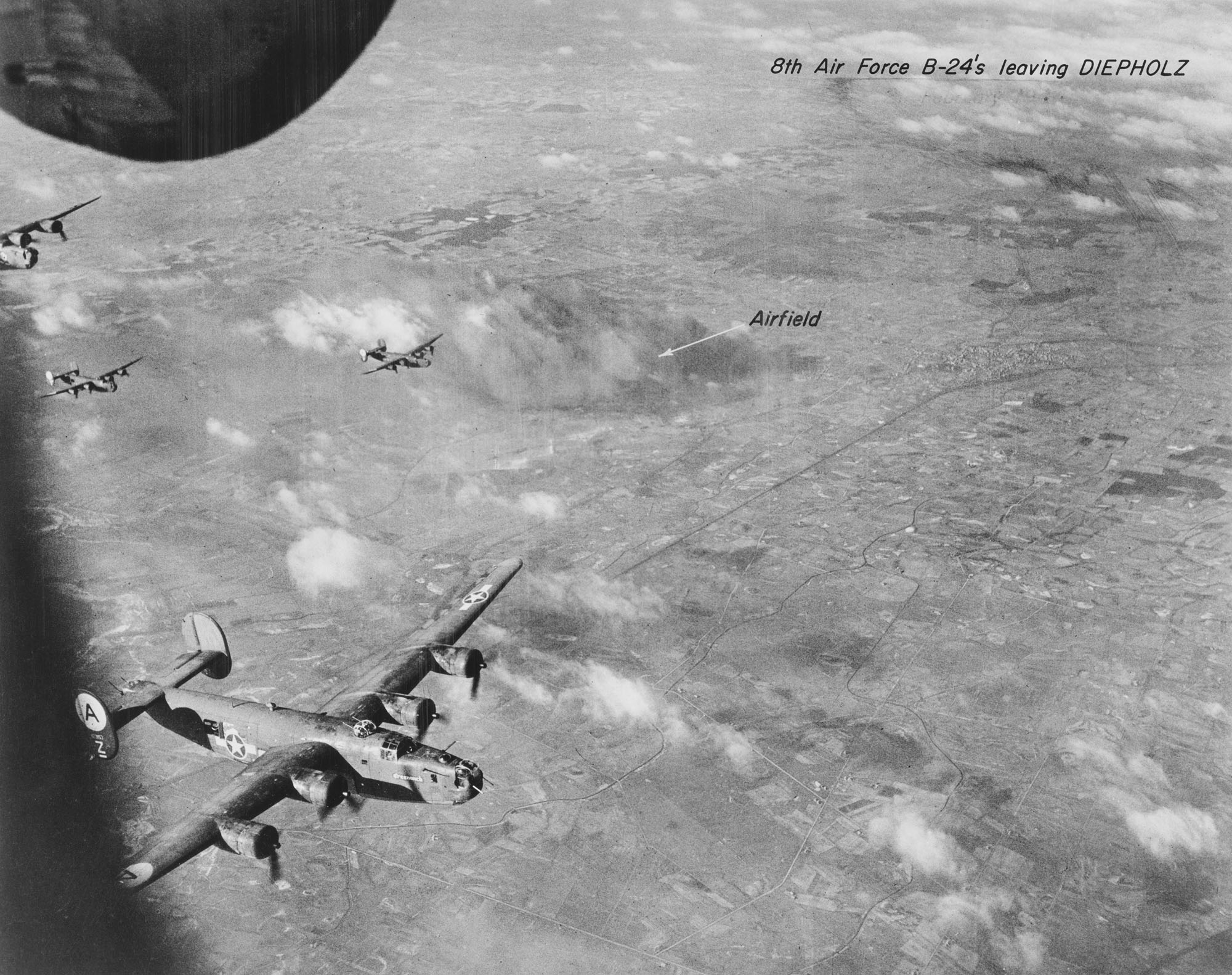
In World War II, the thirty thousand heavy bombers of the U.S. Army Air Forces played a significant role in various missions, including special missions using specially modified B-24D bombers, which were used to provide supplies to underground armed forces in European countries, transport spies and assault teams, and rescue over five thousand downed pilots and crew members.
After the Normandy landings, in the summer and fall of 1944, when General Patton’s forces ran low on fuel, these special B-24 bombers delivered 3,114,264 liters of gasoline to three different airfields in France and Belgium.
The initial batch of B-24 bombers received by the United Kingdom was primarily used for transport and logistics, later being utilized for anti-submarine missions, making a significant contribution to the Allied victory in the Battle of the Atlantic. These B-24 bombers were equipped with radar and searchlights, allowing them to conduct extensive day and night searches for German U-boats, forcing the submarines to surface during the day to have a chance to see the attacking aircraft and use anti-aircraft weapons. It is believed that the B-24 bombers either fully or partially sank 93 German U-boats.
The B-24 bombers were also employed by the U.S. Navy and Marine Corps for anti-submarine operations, anti-ship patrols, and photo reconnaissance in the Pacific theater, while the U.S. Coast Guard used them for patrols and search and rescue operations. Australia also extensively utilized these aircraft.
In early 1942, a group of B-24D bombers were modified into C-87 transport planes, which played an important role in the U.S. Army Air Forces’ airlift operations. In the China-Burma-India theater, C-87s were used for flying over the dangerous “Hump” route across the Himalayas, transporting cargo and fuel from India to China, with some pilots losing their lives in crashes in the valleys.
The C-109 fuel transport plane, converted from the B-24 bomber, was specially designed to support the deployment of B-29 bombers in China, capable of carrying 11,000 liters of fuel. In March 1944, B-24 bombers were deployed in the Chinese theater to combat the Japanese forces. After World War II, B-24 bombers continued to be used for transporting supplies for post-war reconstruction efforts in Japan, China, and the Philippines.
The North American B-25 Mitchell bomber was a twin-engine medium bomber that entered service in 1941, used by many Allied air forces and playing a role in various theaters of World War II. Post-war, many B-25s continued in service for up to forty years. The B-25 spawned numerous variants, with a total production of 9,816, making it the most produced medium bomber in the United States.
The B-25 had a crew of five, a maximum takeoff weight of 15,876 kilograms, a range of 2,170 kilometers, and was equipped with 12 to 18 machine guns and one cannon, capable of carrying Mark 13 torpedoes, eight rockets, or 1,360 kilograms of bombs.
On April 18, 1942, sixteen specially modified and trained B-25 bombers took off from the USS Hornet aircraft carrier, carried out a surprise air raid on Japan, with most of them crash-landing in China. Though the direct damage from this raid was limited, it boosted morale within the U.S. military and instilled fear in Japan, prompting the Japanese to launch an ill-fated attack on Midway Island, resulting in a major defeat.
U.S. service B-25 bombers mostly participated in the Pacific war, showcasing their low-altitude ground attack capabilities, sinking many enemy ships. The aircraft’s powerful machine gun strafing was particularly effective in island campaigns. The operational range of the B-25 also included the Taiwan Strait, the Chinese coast, and Southeast Asia, utilizing skip-bombing techniques to effectively destroy bridges.
In October 1942, B-25 bombers arrived in Egypt, beginning to participate in operations in the Middle East and Italy, providing support for ground operations, conducting sea sweeps, and targeting critical transportation hubs in Italy, Austria, and the Balkans. In October 1943, B-25 bombers were stationed in England, joining the attacks on Germany.
During the Battle of the Bismarck Sea on March 2, 1943, U.S. B-25 bombers and B-17 bombers conducted an airstrike against a large Japanese transport fleet, sinking all eight transport ships and four destroyers, thwarting the Japanese’s large-scale reinforcements to New Guinea, leading to their isolation and eventual failure in the New Guinea theater.
To increase ground and anti-ship firepower, later models of the B-25 bombers were outfitted with up to eighteen machine guns, essentially becoming airborne gunships.
The U.S. Navy designated the B-25 bomber as the PBJ-1, and starting in 1944, Marine Corps PBJ bombers operated from the Philippines, Saipan, Iwo Jima, and Okinawa, conducting nighttime strikes against enemy vessels guided by radar.
The B-25 was provided to various allied nations, including 870 units sent to the Soviet Union, participating in the Battle of Stalingrad. The Republic of China Air Force acquired over 100 B-25 bombers for their operations against the Japanese.
In early 1942, the Martin B-26 Marauder twin-engine medium bomber was first deployed in the Pacific theater, with more later entering service in Europe. Post the Normandy landings, the B-26 provided tactical ground support for the Allies. From February 1941 to March 1945, a total of 5,288 B-26 bombers were produced. The Douglas A-26 attack aircraft later also utilized the B-26 designation.
The early models of B-26 had a higher accident rate during takeoff and landing processes, earning it the nickname “Widowmaker.” Even while landing on short runways, the B-26 needed to maintain a speed of 240 km/h, which caused anxiety among many pilots, as slowing down too much would result in a stall and crash. However, through retraining and aerodynamic improvements in later periods, operating the B-26 bombers became safer for pilots, resulting in the lowest loss rate among all bomber aircraft of the U.S. Army Air Forces by the end of World War II.
The B-26 bomber had a crew of seven, a total weight of 16,783 kilograms, a combat range of 1,850 kilometers, was equipped with eleven machine guns, and could carry a total of 1,800 kilograms of bombs at various attachment points.
The B-26 bombers primarily operated in Europe but also participated in battles in the Mediterranean and Pacific regions. During World War II, the B-26 conducted over 110,000 missions, dropping a total of 136,078 tons of bombs.
In the Battle of Midway in June 1942, four B-26 bombers took off from Midway Island, launching an air raid against the Japanese fleet. While their torpedoes missed their targets, two were shot down, and two suffered severe damage. Surprisingly, the B-26 bombers managed to shoot down a Japanese Zero fighter and strafe the Japanese aircraft carrier “Akagi.” By 1943, the B-26 bombers were gradually replaced by the B-25 bombers in the Pacific theater.
The Lockheed Ventura bomber was another twin-engine medium bomber and patrol aircraft produced by the United States during World War II, with a maximum takeoff weight of 15,422 kilograms and a range of 2,670 kilometers. It could carry 1,400 kilograms of bombs, six 147-kilogram depth charges, or one torpedo, with a total production of 3,028 units. In 1942, the Ventura bombers provided to the UK were first deployed in combat operations in Europe but were soon replaced. The U.S. Army Air Forces designated it as the B-34 reconnaissance bomber and B-37 trainer, while the U.S. Navy named it the PV-1, deploying it for combat operations in the Pacific theater in 1943, mainly used for maritime patrols. Commonwealth forces also used it for various missions, including anti-ship and anti-submarine operations.
The de Havilland DH.98 Mosquito fighter plane was a British twin-engine multi-role heavy fighter aircraft during World War II, known as a fast bomber or attack aircraft, reaching one of the fastest speeds in 1941. With its mainly wooden construction, it was nicknamed the “Wooden Wonder” or “Mossie,” with a total production of 7,781 units, including 6,710 built by Britain and Canada during the war.
The Mosquito fighter had a crew of two, a maximum weight of 11,340 kilograms, a top speed of 668 km/h, a range of 2,100 kilometers, equipped with four machine guns, four cannons, capable of carrying 1,800 kilograms of bombs and utilizing radar navigation equipment.
The Mosquito fighter took on various missions, including medium bombing, reconnaissance, tactical strikes, anti-submarine warfare, attacking ships, and night fighting. In the entire year of 1942, the Mosquito was mainly used for attacking industrial and infrastructure targets in the Netherlands, Norway, France, and northern and western Germany. Despite facing heavy anti-aircraft fire and threats from German fighter planes, the Mosquito’s control and speed allowed it to evade attacks successfully.
Starting in mid-1942, the Mosquito fighter was assigned to night fighting duties, intercepting German bombers during air raids on the UK, while conducting airstrikes on German airfields.
On January 30, 1943, Mosquito fighters destroyed a major broadcasting station in Berlin in the morning, interrupting a speech by German Air Marshal Göring; in the afternoon, during a second sortie, they disrupted a speech by Nazi Propaganda Minister Goebbels.
From June 1943, the Mosquito fighter was introduced in light night strike units, guiding heavy bombers in attacks. Equipped with H2S radar, some Mosquito fighters launched successful large-scale air raids on major German cities as they were used for missions against German U-boats, intercepting enemy convoys.
The best British pilots flying the Mosquito fighter shot down 21 enemy aircraft. During the war, the Mosquito fighter downed 487 German aircraft, most of them during nighttime encounters.
Beginning in 1943, the Mosquito fighter was employed in attacking German U-boats, intercepting enemy fleets.
After World War II, from 1947 to 1949, 180 remaining Mosquito fighters in Canada were transferred to the Republic of China Air Force for combat against the Chinese Communist forces. After 1949, the remaining aircraft were relocated to Taiwan, conducting attacks on Communist naval vessels.
The Bristol Beaufighter Mk.IV was a versatile heavy fighter used by the UK during World War II, operating as a night fighter, ground attack, and torpedo bomber aircraft. Introduced in 1940, production ceased in September 1945, with a total of 5,564 units manufactured.
The Beaufighter fighter had a crew of two, a maximum weight of 11,521 kilograms, a top speed of 510 km/h, a range of 2,820 kilometers, equipped with four cannons, six machine guns, able to carry eight rockets, two 110-kilogram bombs, or one torpedo.
Ali Nachimari – Senior Editor – August 18th, 2026