
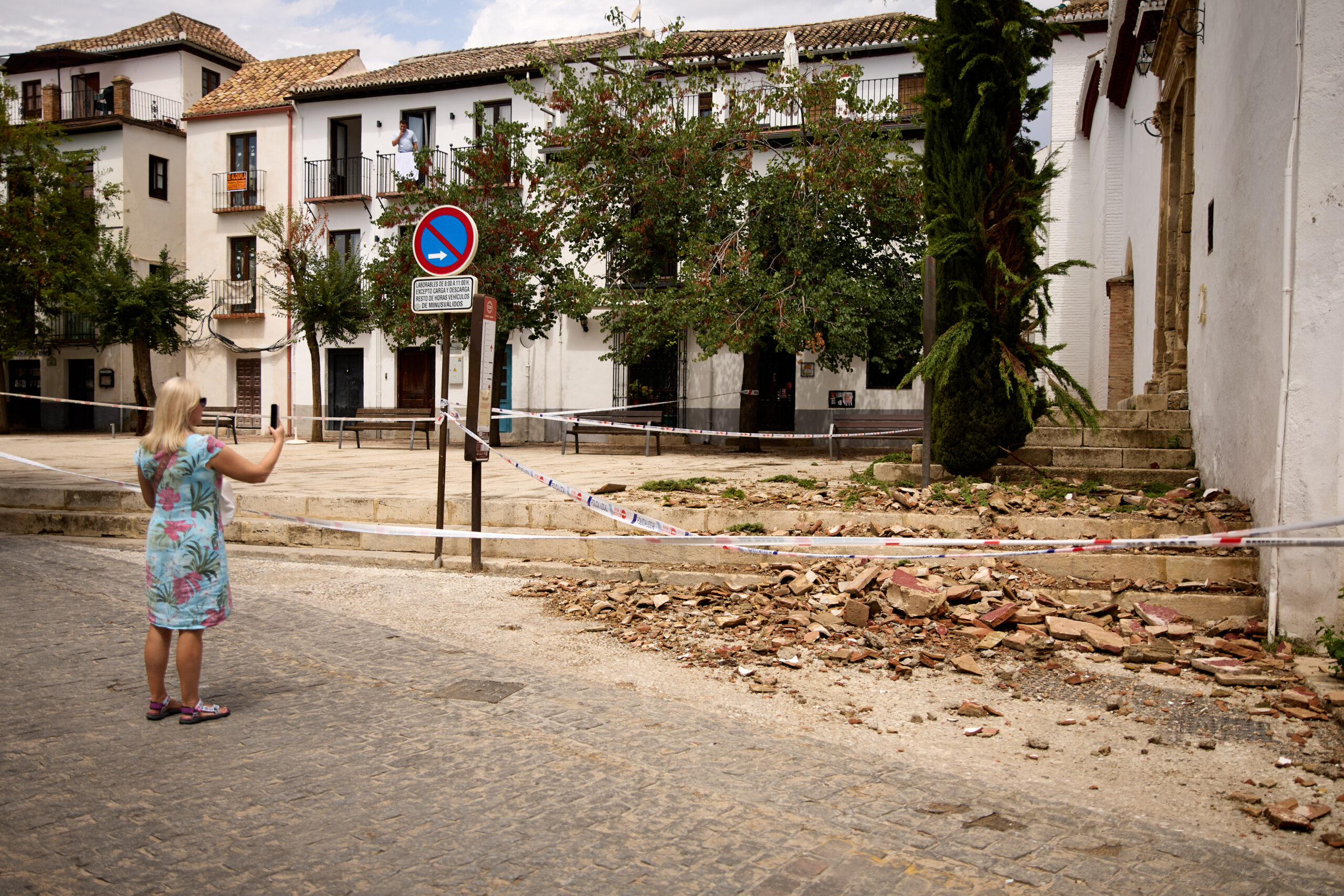
On Saturday at 1:04 am, a 5.2 magnitude earthquake struck the tourist destination province of Granada in the southern Andalusia autonomous community in Spain. The epicenter was near the towns of Otura and Alhendín in the Granada metropolitan area, with a depth of about 10 kilometers.
The sudden shaking in the middle of the night startled numerous residents from their sleep, causing noticeable tremors in various provinces of the Andalusia autonomous community including Malaga, Almeria, and Huelva, sparking public panic.
A journalist from Agence France-Presse in Granada witnessed a large number of broken tiles falling from the roof of a church, prompting tourists to halt and take photos of the scene cordoned off by warning tape.
Photos shared by Spanish media showed debris scattered on the streets and car windows shattered.
“We really felt the tremor, it was too intense, it woke us all up,” said Marta Mayorga Fernandez in an interview with Spanish National Broadcasting Corporation (RTVE) in the town of Huetor Vega on the outskirts of Granada.
She added, “We were a bit panicked at home, my whole body and arms were still trembling.”
In Granada, reports of falling building components, bricks, peeling exterior walls, and damaged roofs were widespread, with some hitting vehicles parked near residences and triggering rockfalls in mountainous areas.
Emergency services received hundreds of distress calls in the hours following the earthquake, with firefighters responding to dozens of incidents. Officially, there have been no casualties reported, and no significant structural damage. The UNESCO World Heritage site Alhambra Palace was unaffected.
Before the main quake, the region had already experienced several foreshocks on Friday, including a notable 3.7 magnitude one. Following the strong earthquake, the area was immediately hit by a series of intense aftershocks, with dozens occurring within hours, some still measuring over 3.0 on the Richter scale.
Due to the impact of the earthquake, the Andalusian government has activated the emergency phase of the earthquake risk plan (Level 1 response status), enhancing coordination between rescue departments and building inspection teams. Authorities and Andalusia Autonomous Community President Juanma Moreno urged people to stay calm, avoid damaged walls, eaves, and balconies, and be cautious of aftershocks and falling objects.
The basin where Granada is located is one of the most geologically active areas in the Iberian Peninsula. Antonio Sanz, the highest emergency official in the Andalusia autonomous community, stated that the last earthquake of this magnitude in Andalusia occurred in 1955.