
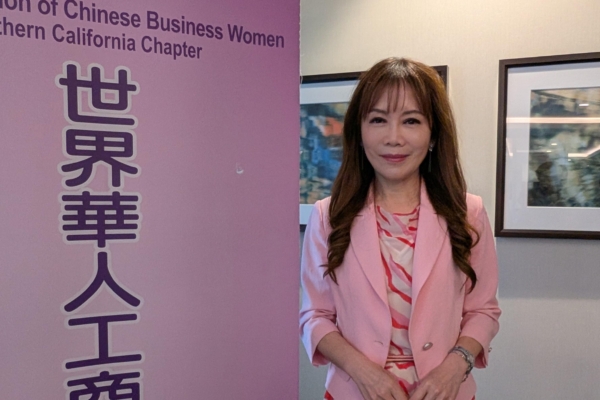
Chen Yalin, who always “arrives late” when meeting friends at the airport, isn’t delaying her schedule, but rather because she has previously conducted interviews in politically sensitive regions such as Iran and North Korea. When entering the United States, she often faces more detailed questioning by customs officers, resulting in longer clearance times compared to regular travelers. For her, these experiences over her 34-year journalism career are a reflection of the unique nature of journalism.
Having reported from locations like North Korea, Iran, Fukushima in Japan, and Hong Kong, she has witnessed firsthand environments where press freedom is restricted. These experiences have deepened her appreciation for the value of democracy, freedom, and human rights in Taiwan. Now, with the rapid changes brought by artificial intelligence (AI), social media, and short video formats in the news industry, she believes that the irreplaceable value of journalism lies not in speed but in verification, truth, and depth.
For Chen Yalin, undergoing detailed questioning during border crossings is not new. Due to work requirements, she has visited many highly politically sensitive countries, thus receiving special “attention.”
She describes herself as one of the few broadcasters in Taiwan’s news industry who has taken an “alternative route,” choosing not to confine herself to reporting news from a studio but instead immersing herself in the front lines, conducting interviews in special and even high-risk areas.
Chen Yalin has visited North Korea twice. During her first visit as a journalist, she faced significant restrictions and control during the interview process. In a subsequent visit, she entered as a scholar, aiming to access information that mainstream media find difficult to reach by bypassing some restrictions through a different identity.
While these experiences can sometimes be inconvenient for Chen Yalin, they serve as reminders that the places where journalists tread and the issues they cover are inherently unique.
Over her 34-year career in journalism, Chen Yalin has progressed from a grassroots reporter to a news director, having served as chief editor, political correspondent, general editor, news department manager, and later as the director of a news channel, and even acting as the general manager of a TV station.
Throughout the years, she has ventured into numerous news scenes that are not easily accessible to the general public, including the Fukushima disaster area in Japan, Iran, North Korea, and the frontlines of the Hong Kong “anti-extradition bill” movement.
She emphasizes that in places lacking press freedom, obtaining factual information as a journalist is not easy, often facing multiple restrictions due to one’s identity, itinerary, and the interview environment, sometimes requiring strategies to overcome layers of control.
Therefore, each time she returns to Taiwan, she feels a deeper appreciation for press freedom: “Every time I return to Taiwan, I feel that we are truly a treasure island, and it is a fantastic country, a land of freedom, human rights, and democracy.”
These frontline experiences have become a significant part of her many years in journalism.
Having transitioned from traditional television news to the AI era, Chen Yalin has witnessed the rapid transformation of the news industry from analog TV and 24-hour news channels to the internet, social media, and short video platforms.
Today, with the flourishing growth of YouTubers, social media influencers, and various content creators, information sources have become more diverse than ever. She believes that while the multitude of voices from all directions in society is positive, news media must uphold the values of professionalism and verification.
“The existence of traditional media does not solely aim to chase after what is considered ‘fast,'” she says. While 24-hour news channels must provide immediate information, the true value of news media lies in in-depth reporting and the pursuit of truth. News must undergo verification, examination, and cross-referencing, setting professional news media apart from general informational content.
As AI advances rapidly, the production of fake news becomes more convincing. From AI-generated text, photos to videos, there is a possibility of synthesized imagery in the future that may be challenging for the general public and news workers to discern.
Chen Yalin believes that regardless of technological advancements, the fundamental professionalism of journalism lies in “verification.” Confirming information sources, cross-checking different messages, and discerning truth from falsehood remain essential skills that are not rendered obsolete by the presence of AI but instead become more critical.
She also stresses that media literacy should not solely be the responsibility of news professionals. In communication platforms like LINE, a piece of information can quickly spread through numerous forwards, potentially disseminating misinformation if recipients lack basic judgment capabilities.
“It’s not just about the media verifying, but everyone possessing a collective media literacy,” Chen Yalin notes. Cultivating the ability to discern the authenticity of information is becoming an essential skill for everyone in the AI era.
Addressing the question of whether AI will replace journalists and anchors, Chen Yalin believes that while technology can indeed change the way news is produced, the core values of journalism will not disappear. The role of future journalists may evolve further.
In the past, the significant task of news media was to “inform the audience of what was happening immediately.” However, with AI capable of generating vast amounts of text, images, and even audiovisual content within seconds, the value of simply providing information will gradually diminish.
The future value of journalists will lie in verifying information, discerning truth from falsehood, getting to the heart of events, understanding the context of incidents, and explaining complex issues clearly.
In other words, when everyone can swiftly publish content, the truly crucial aspect becomes “who is worth trusting.”
Regarding how overseas journalists can introduce Taiwan to the world, Chen Yalin proposes the viewpoint of “the more local, the more international.”
She believes that while Taiwan may be small in size, its stories are far from exhausted. Every parcel of land holds its unique history, culture, and life stories. Rather than deliberately pursuing broad international topics, she suggests starting from Taiwan’s own land and people to unearth topics with unique characteristics.
Using Taiwan’s natural environment as an example, she highlights that Taiwan boasts diverse terrain, ecology, and cultural changes from the ocean to the mountains, creating a distinct blend of natural and human landscapes.
These seemingly local stories, when explored deeply, can also become valuable topics with international appeal.
She sees “the more local, the more international” as a way for Taiwan to narrate its stories to the world.
Through her 34-year journalism career, Chen Yalin has navigated the transitions of the news industry from traditional television broadcasts and 24-hour news channels to the internet, social media, and the AI-generated content era multiple times.
She believes that the future of the news industry will inevitably continue to evolve, but news itself will not disappear. As information becomes faster, content proliferates, and the line between truth and falsehood becomes increasingly blurred, society will increasingly need individuals to step into the scene, verify facts, grasp the background, and clearly convey authentic stories to the public.
For Chen Yalin, while AI can change the format and production process of news, it should not alter the fundamental value of journalism – accountability to the truth.