
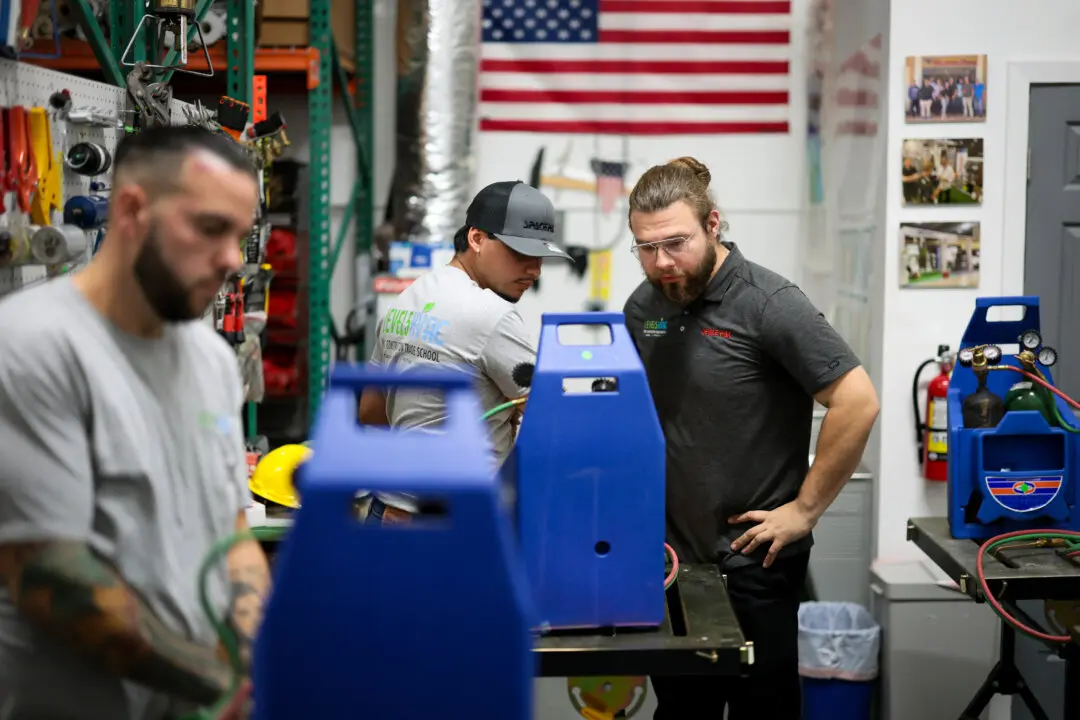
For years, students have been told that the future belongs to those with a four-year college degree. However, today, some of the fastest-growing job opportunities are in the field of technical trades, where the demand for skilled labor continues to rise. Against the backdrop of the rise of artificial intelligence, job security in these fields is also higher.
Amid concerns about job security, more and more students and young workers are opting out of pursuing a four-year college degree and instead choosing vocational training. Generation Z students and young workers are increasingly considering options outside of traditional higher education, showing a growing interest in vocational schools and professional training programs.
The timing couldn’t be more appropriate. Large-scale infrastructure projects are underway, and there is rapid construction of artificial intelligence (AI)-related facilities, leading to a growing demand for workers with practical operational skills. Labor experts suggest that the convergence of these trends could reshape Americans’ views on education and career paths in the future.
“In recent years, people flocked to fields believed to be immune to the impact of artificial intelligence, but then a favorable factor emerged because there is enormous demand for these positions in supporting labor mobility,” said Brady Colby, market research director of Validated Insights, based in Chicago, Illinois. The company specializes in analyzing trends in higher education and vocational schools.
He told Epoch Times that while interest in vocational learning has steadily grown over the years, in the past six months, this interest has “really taken off.”
“Recruiting these skilled workers is now more challenging than recruiting computer programmers,” he said.
According to a report by Validated Insights in June, revenue from vocational schools grew by 11.4% in 2025, exceeding all growth expectations and nearly doubling the initial growth forecast, with revenue exceeding $19 billion.
The Philadelphia Technician Training Institute (PTTI) in Pennsylvania stated on its website that many members of Generation Z choose vocational schools because these institutions provide fast applied education leading directly to high-paying and rewarding careers.
Mike Nager, author of “The Smart Student’s Guide to Smart Manufacturing and Industry 4.0” (2021), told Epoch Times: “For decades, a four-year college degree has been seen as the only path to a reliable future. And trade work has been seen as a fallback for those who cannot or do not wish to pursue a degree.”
However, he noted that making a four-year degree the default choice is no longer as valuable in many cases.
He also believes that focusing solely on education is not enough to address the growing skills gap in the United States.
“It is necessary for children to understand the specific content of the trade industry and gain some hands-on experience. This is where the industry needs to strengthen and devise promotion plans to bridge the ‘awareness gap’ people have about these industries,” he said.
The “awareness gap” refers to the disconnect between the increasing demand for skilled professionals and the public’s perception of these careers. For years, this gap has been thought to fuel a bias in society that vocational education only leads to physically demanding or low-paying jobs, while also creating a favorable environment for traditional university education.
Behavior analyst and CEO of an advertising company, Cyrus Kennedy, stated that attitudes towards technical trades are undergoing significant changes.
“It’s both a math problem and a psychological shift,” he explained to Epoch Times, “Generation Z has witnessed the millennial generation before them burdened with six-figure student loans for degrees that couldn’t guarantee them jobs.”
Kennedy stated that the trend of considering vocational education as equal to higher education opportunities is happening as people become “increasingly tired of purely digital and screen-based jobs.”
“Young people are realizing that professional skills can provide immediate income potential, job security that is not easily replaced by artificial intelligence, and a clear path to entrepreneurship without the economic burden of a four-year college degree,” he said.
Kennedy expressed that people are re-evaluating another assumption about career development in technical trades: that there are limits to career advancement and risks of physical strain.
“In reality, the trade industry is one of the fastest paths to entrepreneurship,” he said, “Plumbers or electrical apprentices not only learn how to repair pipes, but they also learn business models. Many ultimately transition into project managers, estimators, or business owners. This requires high-level problem-solving skills, knowledge of customer psychology, and financial literacy.”
Steven Morgan, a licensed senior plumber and certified HVAC technician at 24hr.Supply, echoed this sentiment. However, he also pointed out that many technical trades still involve substantial physical labor and should not be underestimated.
“It’s physically demanding. You might be working in an attic in August, and real income comes after years of obtaining licenses and gaining experience,” he said. “What students often overlook is the ceiling in career development – starting from a field technician, foreman, estimator, then becoming your own boss. Those who understand this from the start can go a long way.”
He also didn’t find the surge in interest in technical trades surprising.
“Young people have seen the previous generation burdened with heavy debts for degrees that may not yield equivalent returns, so they weigh the pros and cons and conclude: apprenticeships involve learning on the job while making money, rather than spending money to learn. Moreover, these jobs cannot be outsourced overseas or handed over to software,” Morgan added.
“No app is going to replace a licensed plumber.”
By 2026, the industries facing the most severe shortage of technical workers include electricians, welders, HVAC technicians, plumbers, and heavy equipment mechanics.
Meanwhile, according to the U.S. Bureau of Labor Statistics, the average wages for many positions in these trades are now equivalent to or higher than many professions requiring a four-year college degree.
Public surveys also reflect a growing interest in technical professions. A survey conducted in January by Resume Templates on 1,250 Generation Z adults found that 60% of respondents plan to pursue “blue-collar” jobs by 2026. The primary reason cited was that blue-collar jobs provide better long-term job security and offer protection against job loss due to artificial intelligence.
In May, research released by the job transitioning service company Challenger, Grey & Christmas showed that planned layoffs due to artificial intelligence reached a record high of 38,579 people. Layoffs related to artificial intelligence accounted for 40% of all reported layoffs, compared to 7% in January and 26% in April.
In rebuilding the American technical workforce, two main factors are coming together.
On one hand, millions of technical workers are planning to retire by 2032. On the other hand, ongoing data center and infrastructure construction in the U.S. is triggering a talent crisis.
From now until 2032, an estimated 18.4 million workers aged 55 to 64, with higher education credentials and planning to retire, are expected. During the same period, 13.8 million workers aged 16 to 24 with the same credentials are entering the workforce, significantly fewer than the number of retirees.
Meanwhile, an analysis by Randstad shows that due to the booming development of data centers, the demand for technical workers in the U.S. is continuously growing. The demand for robotics technicians has increased by 107%, HVAC professionals by 67%, and construction-related positions by 30%.
Tech giants such as Google, Meta, and Amazon Web Services have introduced their own technical worker training programs to expand their recruitment scope.
However, nearly every industry is feeling the shortage of talent, and there is no shortcut to replacing the aging talent pool in America.
“It’s a retirement wave,” Morgan said, “My technical workers have gone to larger companies… but the bigger issue is that those who once mentored me, the older generation, are gradually aging, and the judgment they have accumulated over decades is disappearing.”
“You can teach code and technology in a classroom, but there’s no shortcut to cultivating intuition in people to anticipate system failures before they happen.”
Modern vocational skills training is also advancing in parallel with technological prosperity, which adds another layer of challenge.
“They’re highly digitized now. Modern apprentices are no longer just reading paper blueprints; they’re using 3D modeling, diagnostic software, and advanced automation equipment,” Kennedy remarked.
“The essence of modern tradesmen is that they are skilled experts who work with their hands. Training programs have evolved to focus heavily on adaptability, business operations, and technical integration because the success of trade enterprises today depends not only on their physical tools but also their software architecture.”
Morgan shared a similar sentiment. “Ten years ago, training was mainly hands-on pipe work,” he said, “Now good training programs teach digital diagnostics, interconnected systems, and software knowledge, because if a tradesman cannot correctly record job details, they’re essentially only half useful.”
In conclusion, the shift in perception toward technical trades as viable career paths is a response to the changing landscape of the job market and the increasing demand for skilled workers. As the importance of vocational education and training becomes more apparent, individuals are embracing the opportunities offered by technical careers, recognizing the tangible benefits they provide in terms of job security, income potential, and avenues for professional growth and entrepreneurship. The evolving nature of vocational training programs to incorporate digital skills and advanced technologies underscores the dynamic and adaptable nature of the trades industry in meeting the demands of the modern workforce.